

MacroInsights: Exceptional Credit Growth—What Does It Signal?
Reading Time: 3 minutesMacroInsights, a Centre for Social and Economic Progress (CSEP) series, dissects key economic developments and policy issues of macroeconomic significance. It offers timely, evidence-based analysis to inform public debate and policymaking.
Post-war surge in bank lending reflects consumption financing and non-bank substitution, not a corporate capex revival.
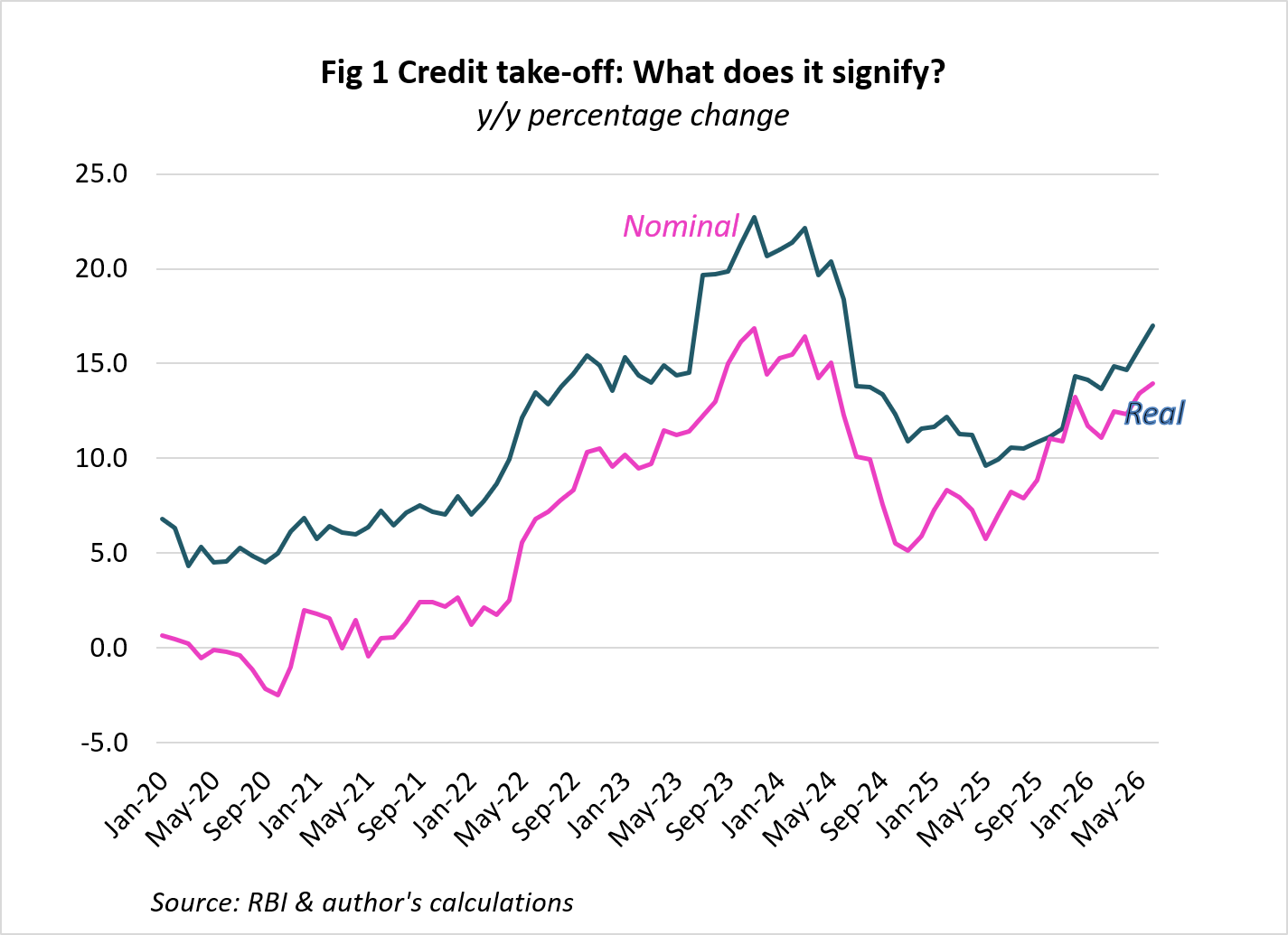
Bank credit growth in the first post-West Asia war quarter has surprised with its strength. Nominal credit growth jumped to a monthly average of 17 per cent in April–June 2026, up from 11.3–11.7 per cent in the same quarter over the past two years. Real credit growth was equally robust, into double digits from sub-10 per cent (Figure 1)—evidence that the economy weathered the price-cum-supply shock better than feared.
Banks extended Rs 5 trillion in what is normally a lean quarter—unusual against last year, less so against post-pandemic history. FY24 Q1 saw a bigger surge (Rs 7 trillion), while FY23 Q1 was similar (Figure 2). What makes this year’s deviation notable is that FY27 Q1, unlike those years, is not a pent-up-demand recovery quarter. Of the total, Rs 2 trillion went to industry and Rs 1.4 trillion of it to large industry alone.
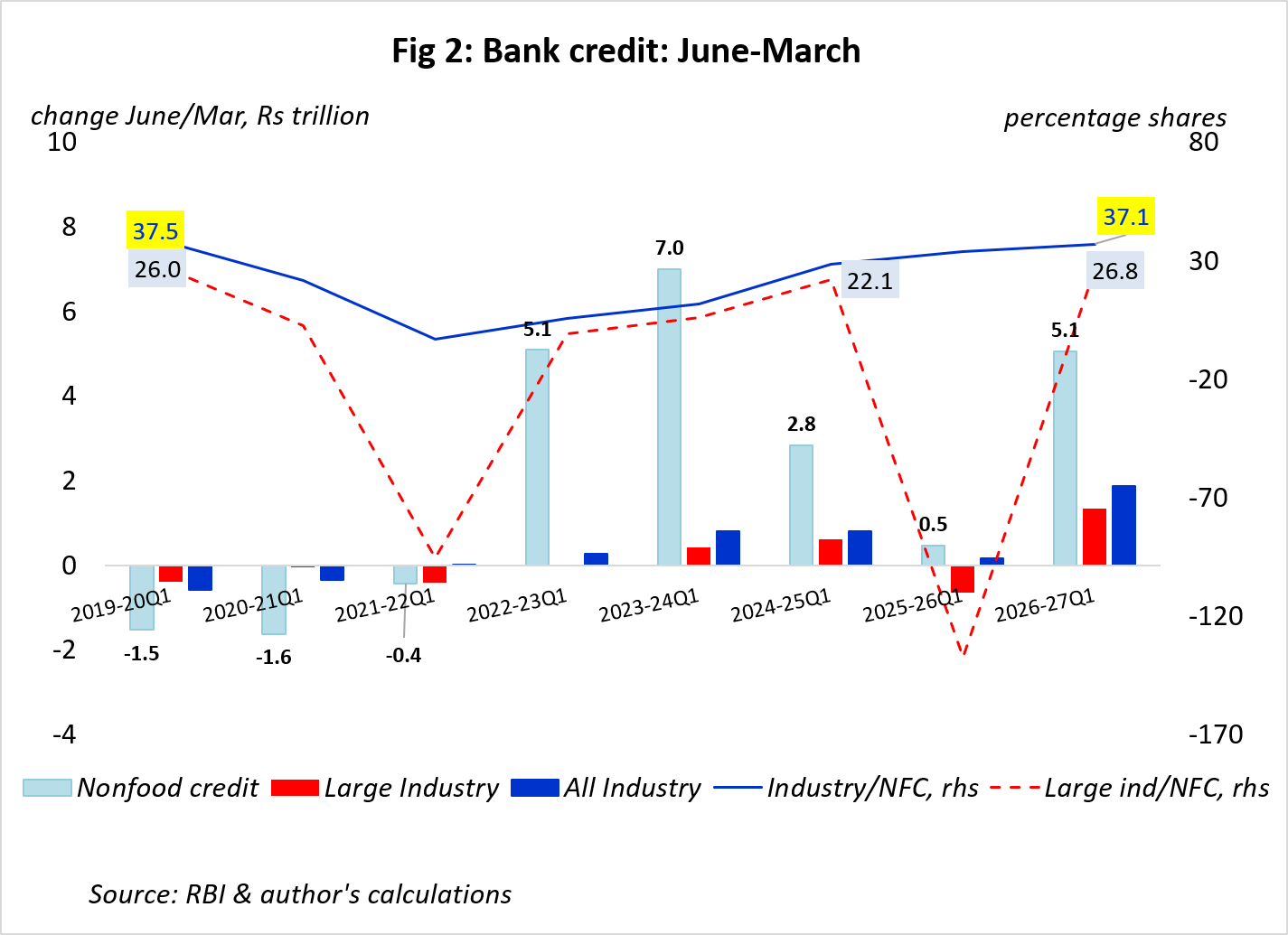
Does it signal a turn in the corporate investment cycle? Two features argue against it. First, large industry’s share of total bank credit is no higher than in FY20 Q1—the pre-pandemic quarter of the year when real GDP growth had slumped to 3.9 per cent. Second, the credit uplift is broad-based: services and personal loans are outpacing industry, not trailing it (Figure 3).
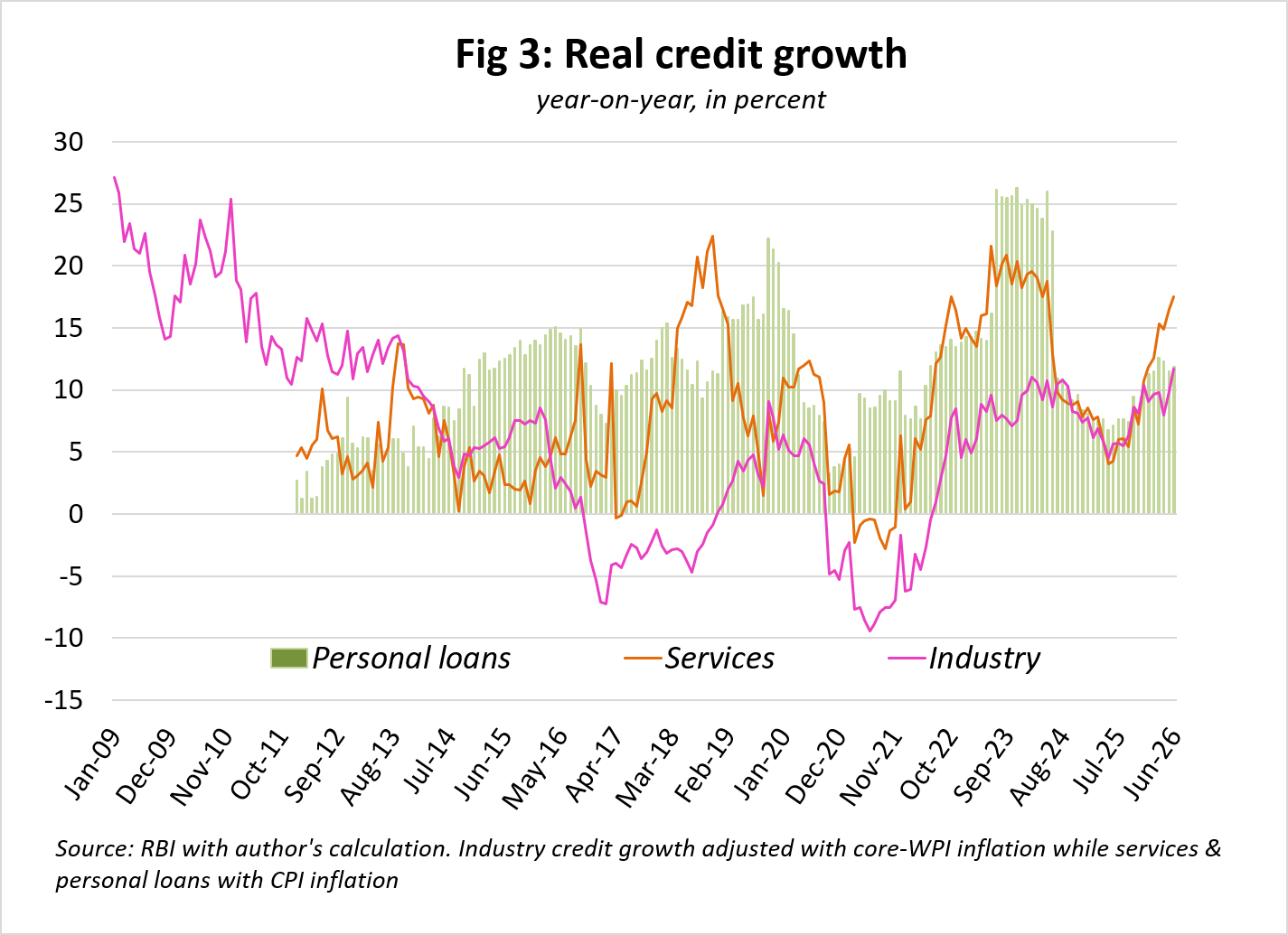
More likely, this is last year’s policy stimulus still playing out. Within personal loans, gold loans are driving the growth, not housing or vehicle loans, which are moderating. NBFC data corroborate this: gold and consumer-durable loan growth stayed strong through the quarter even as total retail loan growth matched last year’s pace. This is the FY26 policy mix—125 bps of rate cuts and GST cuts on mass-consumption goods, including vehicles—still working through the system, sustaining consumption financing rather than kickstarting investment.
Credit substitution is doing some of the work too. RBI data on resource flows to the commercial sector show non-bank financing down ~45 per cent in April–June 2026 over the same period last year—this early cut excludes NBFC flows, which had already contracted 30 per cent, or Rs 1.9 trillion, in FY26. Separate NBFC data show outstanding credit growth barely changed—2.7 per cent between end-March and June 2026 versus 2.5 per cent a year earlier. Banks, in other words, are substituting for non-bank lenders more than they are financing new investment.
Private investment revival needs firmer footing before it can be called one. Industry-wise credit deployment shows no exceptional rise anywhere, barring the usual larger draw from power. The evidence so far points to consumption financing and credit substitution, not a corporate capex turn— that signal will need to hold for longer before it is real.
Read Previous Articles:
MacroInsights: Borrowed Time—Household Debt Can No Longer Mask India’s Consumption Slowdown
MacroInsights: Rupee Pressures—Then and Now: Why This Isn’t 2013 but a Structural BoP Problem
MacroInsights: Gulf War Shock—How Resilient is the Economy
MacroInsights: Crowding-Out? Shrinking Savings, High Public Borrowing Impact Interest Rates

Renu Kohli



Find on this page

The Centre for Social and Economic Progress (CSEP) is an independent, public policy think tank with a mandate to conduct research and analysis on critical issues facing India and the world and help shape policies that advance sustainable growth and development.