
Greening India’s MSMEs: What Role Have International Partnerships Played?
Reading Time: 7 minutesIndia’s Micro, Small, and Medium Enterprises (MSMEs) are a core part of the nation’s industrial economy, accounting for ~50% of the country’s manufacturing exports, ~30% of Gross Domestic Product (GDP) and employing over 328 million people. They are also responsible for 25% of the country’s industrial emissions, making their decarbonisation trajectory inseparable from the country’s own climate commitments, particularly its 2070 net-zero goal. Yet, despite decades of fragmented efforts, greening of MSMEs remains shallow, with 31% using energy-efficient products and 21% using renewable energy technology.
The decarbonisation of MSMEs is becoming increasingly important given various international regulatory pressures, including carbon border adjustment mechanisms (CBAM). Compliance is only part of the story, though. Energy security has also become just as urgent a concern
The decarbonisation of MSMEs is becoming increasingly important given various international regulatory pressures, including carbon border adjustment mechanisms (CBAM). Compliance is only part of the story, though. Energy security has also become just as urgent a concern, with fossil-fuel price shocks in 2022 and 2026. This has resulted in a lack of availability or high prices of resources such as natural gas in the commercial sector, pushing MSMEs to think about energy alternatives. How MSMEs adapt to these pressures will determine their competitiveness in global supply chains.
Increasing Pressure for MSME Decarbonisation
Today, the pressure to decarbonise MSMEs comes primarily from three European Union (EU)-driven mechanisms: (1) a carbon adjustment mechanism, (2) a supply-chain due-diligence directive, and (3) an expanding set of producer-responsibility rules. Table 1 sets out what each mechanism actually does, and where it currently stands. While compliance pressure currently comes only from the EU, countries such as the United Kingdom (UK), Australia and Canada are also set to impose their own carbon-related trade measures.
Table 1: International Drivers For the Greening of Indian MSMEs
| Driver | What it Does | What it Actually Mandates | Status, 2026 |
| CBAM (EU & UK) | Levies a carbon price on imports of steel, aluminium and other covered goods entering the EU. | No emissions cut: payment for embedded carbon at the border; lower-carbon production becomes cheaper to export. | EU: Definitive phase from 1 Jan 2026; Certificate purchase begins Feb 2027, covering 2026 imports; first declaration and surrender due 30 Sept 2027. Adjustment factor: 2.5% of embedded emissions in 2026, rising to full (100%) application by 2034.
UK: Confirmed start on 1 Jan 2027, GBP 50,000 registration threshold; indirect emissions excluded until at least 2029. |
| Corporate Sustainability Due Diligence Directive (CSDDD)
[EU] |
Intended to cascade supply-chain audit requirements to Indian MSME suppliers. | No direct obligation on Indian MSMEs: Mandates due diligence and climate transition plans for large EU companies; Indian suppliers feel it only as a cascade – data requests, audits, contractual clauses from buyers. | The 2026 Omnibus I package narrowed scope to firms with 5,000+ employees AND EUR 1.5bn+ worldwide turnover. Member states must transpose by 26 July 2028; the directive applies to in-scope companies from 26 July 2029. Near-term pressure now comes mainly from buyers, not the regulation itself. |
| Extended Producer Responsibility
(EPR) [EU] |
Shifts end-of-life waste-management costs and reporting obligations onto producers and, indirectly, their suppliers. | Not a carbon rule: Mandates responsibility for a product’s end-of-life – collection, recycling, waste handling. Any emissions benefit is incidental, not the target. | EU-wide EPR schemes must be operational by ~April 2028 (micro-enterprises get until 2029); India’s own domestic EPR for plastics/e-waste/batteries give partial exemptions to MSMEs. |
International Partnerships for Greening MSMEs
International partnerships have played an important role in efforts to green India’s MSMEs. Over the decades, United Nations (UN) agencies, development banks, bilateral donors, and climate funds have supported programmes across different clusters and sectors, working with a range of domestic counterparts.
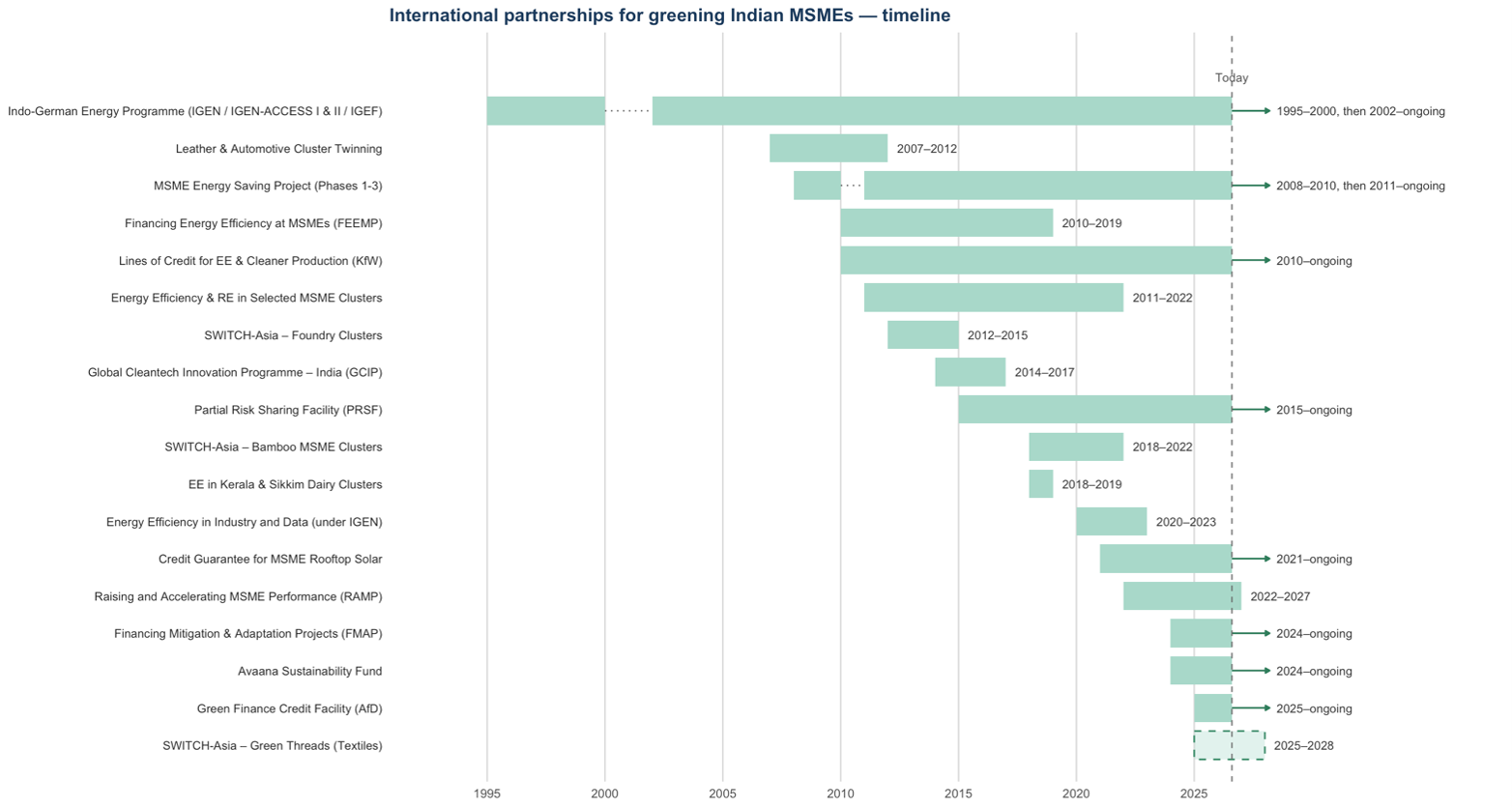
The discussion below draws on a mapping of 18 international programmes supporting the greening of Indian MSMEs (Figure 1). The full programme-level details—including international partners, domestic counterparts, timelines, motivations and reported scale or reach—are provided in Table 2 for reference.
Figure 1: Timeline of projects
Source: Authors’ compilation based on secondary, publicly available data. May not be exhaustive.
International partnerships have been a vital part of India’s efforts to green its MSME sector. The changing nature of these partnerships reflects how the relationship and priorities of the donor organisation and India has evolved. Initial grant based approaches for technical assistance, have moved towards concessional financial lending
Trends Emerging From This Mapping
- International partners: The landscape is dominated by multilateral and bilateral actors. The World Bank and UN-backed organisations are the most prominent multilateral partners. The EU and its member states, particularly Germany and France, are the most prominent bilateral partners, with Japan also playing a role.
- Domestic nodal partners: Early programmes were anchored with the Bureau of Energy Efficiency (BEE) or Energy Efficiency Services Limited (EESL) as the near-default domestic counterpart. From 2010 onwards (Figure 1), funders such as the World Bank (through FEEMP), dedicated climate funds (GCF), and bilateral development finance institutions (AFD, KfW) have increasingly worked through SIDBI. This could reflect a turn from anchoring initiatives within a technical framework towards more financial engagement with MSMEs.
- 9Timelines: Germany’s first project began in the mid-1990s, under the Indo-German Energy Programme (Figure 1). This was an early outlier, with most MSME greening projects starting after 2007. Since then, there has been steady momentum, with new projects being launched or existing ones extended every one or two years.
- From energy efficiency to decarbonisation: Programmes designed before 2015—GEF-UNIDO-BEE, FEEMP, GCIP, and the earlier decades of IGEN—were framed primarily around energy efficiency and cost savings. Programmes designed after the Paris Agreement, including FMAP, Avaana, AFD-SIDBI, and Green Threads, are framed explicitly around climate mitigation and green finance.
- From grant mechanisms to capital deployment: The two largest transactions in the dataset—GCF-SIDBI FMAP (USD 215.6 million, approved in July 2024) and AFD-SIDBI (USD 100 million, signed in February 2025)—were both finalised in the past two years. They function more as capital-deployment instruments than the grant-funded technical assistance that defined much of the 2010s.
- Geography and sector patterns: Across the eighteen programmes, foundry and metal-casting clusters (Kolhapur, Belgaum, Coimbatore, and Ludhiana–Jalandhar, Batala, Jaipur and Howrah under SWITCH-Asia’s foundry project) have attracted the largest number of distinct partnerships, followed by textiles (Surat, Tiruppur, Panipat) and a smaller, more recent cluster of activity around dairy processing, bamboo products, and early-stage clean-tech firms.
- Larger projects are broader, while smaller ones are more targeted: Larger projects from JICA, KfW, and AFD have established SIDBI-routed concessional credit lines that lend nationally. In contrast, SWITCH-Asia runs separately designed, sector-specific projects covering foundry and bamboo clusters, as well as Green Threads in Panipat. This allows it to target individual clusters with precise interventions.
- Gaps in programme coverage: Of the eighteen programmes, eight have concluded, and nine remain open-ended, while Green Threads has a fixed timeline to 2028. Activity remains concentrated in recurring clusters (Tiruppur, Belgaum, Panipat, Kolhapur) rather than being distributed evenly. Secondary steel and chemicals, which will also be affected by CBAM, remain comparatively underserved relative to foundry, textiles, and dairy.
Going forward, it will be important for policymakers to understand how to leverage these partnerships to further expand these schemes for Indian MSMEs to adapt to the growing pressures they face in staying globally competitive in a world that increasingly demands green compliance
Looking Ahead
International partnerships have been a vital part of India’s efforts to green its MSME sector. The changing nature of these partnerships reflects how the relationship and priorities of the donor organisation and India have evolved. Initial grant-based approaches for technical assistance have moved towards concessional financial lending. International agencies used to partner with BEE, but today have SIDBI as the Indian counterpart. The focus has slowly been moving from merely energy efficiency to green energy implementation. However, the type of industry and geographical focus remain limited. Going forward, it will be important for policymakers to understand how to leverage these partnerships to further expand these schemes for Indian MSMEs to adapt to the growing pressures they face in staying globally competitive in a world that increasingly demands green compliance.
Table 2. Mapping of International Partnerships for Greening Indian MSMEs
Scale/Reach figures reflect the most recent disclosed budget, leverage or cluster-reach metric for each programme.
| Programme | Actor Type | Domestic Counterpart | Period | Primary Motivation | Scale/Reach |
| MULTILATERAL | |||||
| Leather & Automotive Cluster Twinning | UN agency (UNIDO), Italy-funded | DC-MSME, DIPP | 2007-2012 | Cleaner production/tech transfer | USD 3.5mn (Government of Italy); leather clusters (Chennai, Shantiniketan), automotive clusters (Chennai, Pune, NCR Delhi) |
| Financing Energy Efficiency at MSMEs (FEEMP) | MDB (World Bank) + GEF | SIDBI, BEE | 2010-2019 | Energy efficiency | USD 57.5mn total programme;
1257 MSMEs implemented changes |
| Energy Efficiency & RE in Selected MSME Clusters | UN agency (UNIDO) + GEF | BEE | 2011-2022 | Energy efficiency | 12+ clusters nationally (5 sectors); total GEF grant USD 7.17mn per terminal evaluation |
| Global Cleantech Innovation Programme – India (GCIP) | UN agency (UNIDO) | DC-MSME, FICCI | 2014-2017 | Energy efficiency/cleantech entrepreneurship | 4 annual competitions, 700+ applications, ~84 SMEs qualified; USD 4mn budget |
| Partial Risk Sharing Facility (PRSF) | MDB (World Bank) + GEF/CTF | SIDBI, EESL | 2015-ongoing | Energy efficiency finance | USD 43mn total (USD 37mn risk-sharing + USD 6mn TA); 45 EE projects supported to FY2022 |
| EE in Kerala & Sikkim Dairy Clusters | UN agency (UNIDO) | BEE | 2018-2019 | Energy efficiency | 120 DPRs in 12 clusters; INR 2.08cr annual savings on INR 4.20cr investment in Kerela; ~13mn USD total budget |
| Financing Mitigation & Adaptation Projects (FMAP) | Climate fund (GCF) | SIDBI | 2024-ongoing | Climate mitigation/adaptation | USD 215.6mn approved (USD 15.6mn grant + USD 200mn concessional loans) |
| Avaana Sustainability Fund | Climate fund (GCF) | SIDBI | 2024-ongoing | Climate finance/cleantech | GCF grant of USD 24.5mn within a USD 120mn funding round |
| Raising and Accelerating MSME Performance (RAMP) | MDB (World Bank) | MoMSME; States/UTs (via SIPs) | 2022–2027 | MSME competitiveness & institutional strengthening (one of several DLI streams) | USD 808mn total outlay (USD 500mn WB, result-based via DLIs); targets 5.5 lakh MSMEs; 46% of WB assistance claimed as of 2024 |
| BILATERAL | |||||
| Indo-German Energy Programme (IGEN)(predecessor); IGEN-ACCESS; IGEN-ACCESS II; Indo-German Energy Forum (IGEF) | Bilateral dev. agency (GIZ, Germany) | BEE | 1995-2000 (predecessor project); 2002-ongoing (IGEN) | Energy efficiency | €6.62 million (IGEN-ACCESS I, 2015-2019); €5.5 million (IGEN-ACCESS II, 2019-2024) |
| MSME Energy Saving Project (Phases 1-3) | Bilateral dev. agency (Japan, ODA) | SIDBI | Phase 1: 2008-2010; Phase 2: 2011-2014; Phase 3: 2014-ongoing | Energy efficiency | JPY 30bn per phase; ~JPY 90bn cumulative; 5,000+ sub-projects |
| Lines of Credit for EE & Cleaner Production | Bilateral DFI (kFW) | SIDBI | 2010-ongoing | Energy efficiency | ~EUR 140mn cumulative, confirmed by KfW |
| SWITCH-Asia – Foundry Clusters | Regional bloc (EU) | BMOs / industry assoc. | 2012-2015 | Energy efficiency/sustainable production | EUR 2.07mn;
500 direct + 460 indirect MSMEs in 4 clusters |
| SWITCH-Asia – Bamboo MSME Clusters | Regional bloc (EU) | Local FAs, SIDBI | 2018-2022 | Green materials/market access | 1981 SMEs benefitted, EU 3.81mn financing |
| Energy Efficiency in Industry and Data (under IGEN) | Bilateral dev. agency (Germany, BMZ) | BEE, State Designated Agencies | 2020–2023 | Energy Efficiency | EUR 4mn for technical assistance; SDA capacity-building, non-PAT cluster peer-learning |
| Credit Guarantee for MSME Rooftop Solar | Bilateral dev. agency (USA) + DFI (DFC) | cKers Finance, Electronica Finance Limited (NBFCs) | 2021–ongoing | De-risking MSME investment in RE/rooftop solar | USD 41mn credit guarantee; first 3 months: 15 projects, $800,000 loaned in textiles, manufacturing, food processing, packaging; 6-month pipeline (as of Sep 2021): USD 4mn across 49 rooftop projects, 50 micro-cold chains, 350 rural bank branches |
| Green Finance Credit Facility | Bilateral DFI (AfD) | SIDBI | 2025-ongoing | Climate/green finance | USD 100mn credit facility |
| SWITCH-Asia – Green Threads (Textiles) | Regional bloc (EU) | FMC, SIDBI, BEE | 2025-2028 (planned) | Carbon reporting/circularity | EUR 1.8mn total (EU funds 80%); targets 14,800 MSMEs, 250,000 workers |
Source: Authors’ compilation based on secondary, publicly available data. May not be exhaustive.


Pooja Ramamurthi

Find on this page

The Centre for Social and Economic Progress (CSEP) is an independent, public policy think tank with a mandate to conduct research and analysis on critical issues facing India and the world and help shape policies that advance sustainable growth and development.