
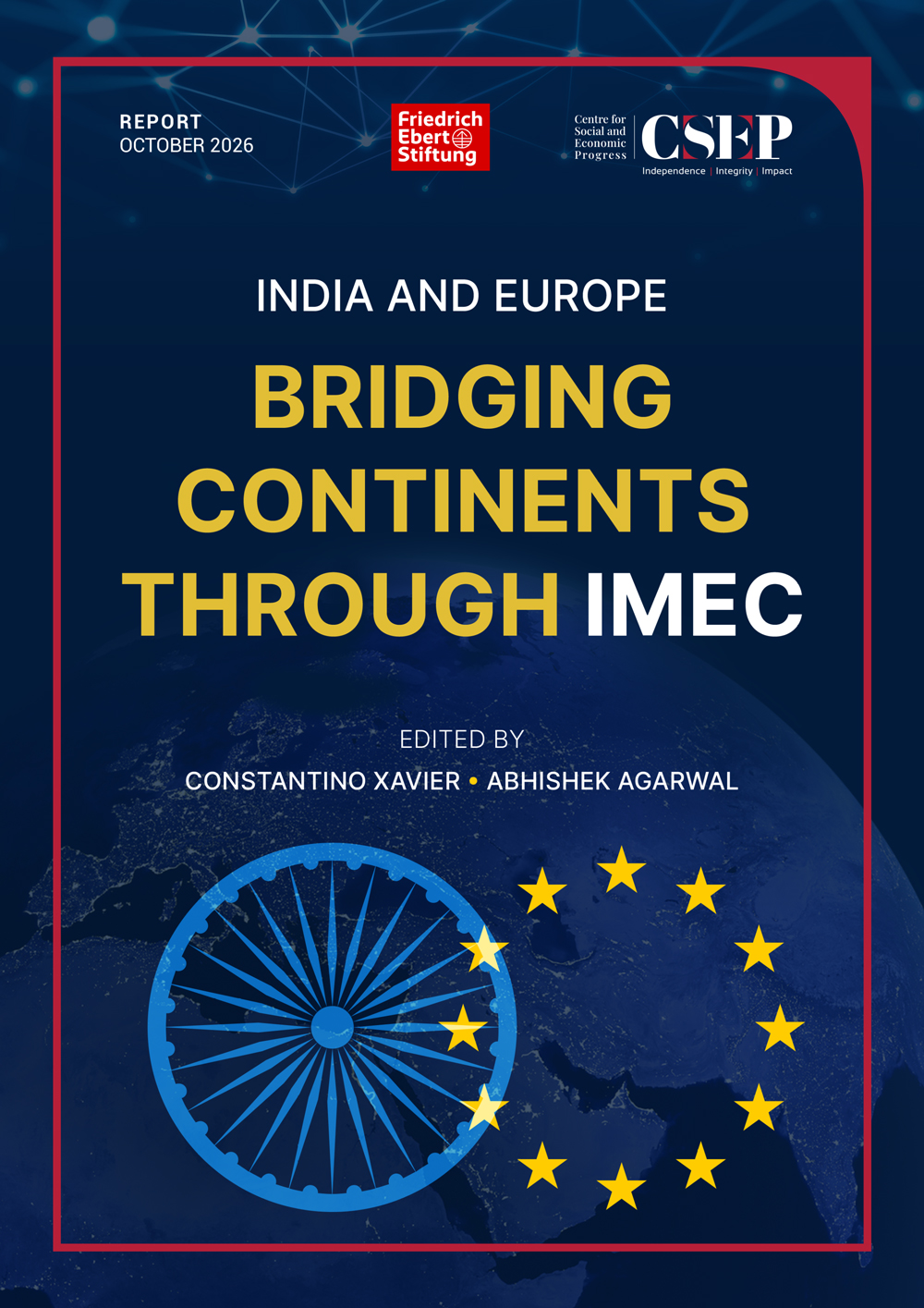
India and Europe: Bridging Continents Through IMEC
Reading Time: 5 minutesDOWNLOADS
Executive Summary
Reconnecting India and Europe in an Era of Fragmentation
In a world adrift, marked by conflict and fragmentation, India and Europe represent a rare example of intensifying cooperation and geoeconomic convergence. As two of the largest economies and democracies in the world, the European Union (EU) and India will need to craft new, interoperable systems and instruments for economic interdependence to advance their convergence.
As this volume shows, the successful implementation of the India–Middle East–Europe Economic Corridor (IMEC) as an Indo-Atlantic connectivity partnership between India and Europe will require far more than investments in ports, railways, and logistics infrastructure. It will depend equally on policy coordination, regulatory interoperability, digital integration, institutional governance, financial structuring, and sustained political engagement across all participating geographies and beyond, including adjacent regions: from Southeast Asia to the North Atlantic and from Central Asia to North and East Africa.
IMEC emerged amid intensifying geopolitical fragmentation and growing concern about the resilience of global trade, energy, and digital networks. Since its announcement in 2023, the war in Ukraine, conflict in Gaza, disruptions in the Red Sea, and the Strait of Hormuz crisis have exposed the risks created by concentrated trade routes and strategic chokepoints. In parallel, India and Europe have deepened economic and strategic cooperation through the conclusion of negotiations on the India–EU Free Trade Agreement (FTA) and a broader agenda focused on supply-chain resilience, connectivity, and economic security.
In this context, IMEC has evolved from a connectivity initiative into a wider resilience project. While originally conceived as a multimodal corridor linking India, the Gulf, and Europe through transport, energy, and digital infrastructure, its strategic significance today extends beyond logistics. The corridor has become a test case for whether India, Europe, and their regional partners can build new frameworks for economic interdependence capable of operating in an increasingly unstable international environment.
The central conclusion of this volume is that India and the European Union should not pursue IMEC as a mere transport corridor but as a resilient economic network connecting India, Europe, and West Asia through interoperable infrastructure, energy systems, digital platforms, investment mechanisms, regulatory cooperation, and shared security arrangements.
From Corridor to Economic Network
IMEC should not be treated as a single route, a geopolitical symbol, or a substitute for the Suez Canal. It should be developed as a flexible and adaptive network that provides redundancy, optionality, and resilience.
Developed independently across different geographies and sectors, the contributions reflect European, planning, logistics, and strategic perspectives, yet converge on a conclusion: IMEC should provide route diversification, multimodal redundancy, interoperable systems, and wider regional integration. Together, these elements support a broader conception of IMEC as an economic network rather than a transport line. The same holds true for India’s interests in IMEC This network logic applies across multiple domains. Physical infrastructure requires alternative port access points, complementary maritime gateways, and redundancy in routing. Digital systems require interoperable customs platforms, payments architecture, and data standards. Energy connectivity requires interconnected electricity grids, green-hydrogen corridors, and cross-border regulatory cooperation. Security depends on coordinated approaches to maritime protection, critical infrastructure resilience, and crisis response.
These principles provide the basis for assessing IMEC’s economic, security, energy, climate, and political dividends. New Delhi, Brussels and European capitals will have to coordinate policy across these different domains.
The Four Strategic Dividends of IMEC
This report shows that IMEC could serve as a catalyst to reconnect Europe and India after decades of divergence and disruption. From a geoeconomic perspective, IMEC should form the strategic heart of a broader India-EU connectivity partnership towards linking the Indian and Atlantic oceans. The success of this Indo-Atlantic economic initiative rests on four dividends.
Economic Dividend
The economic case for IMEC rests on reducing transit time, uncertainty, and trade frictions. Modelling presented in this volume suggests that a 40% reduction in transit time between India and Europe could add approximately US$3.535 billion to India’s Gross Domestic Product (GDP). The gains would extend across manufacturing, electronics, textiles, automotive components, and selected agricultural exports.
Beyond direct trade gains, IMEC could strengthen regional value chains, improve competitiveness, support implementation of the India–EU FTA, and accelerate integration with Gulf and European markets.
Security Dividend
The corridor’s strategic relevance has increased because of repeated disruptions affecting maritime trade routes. IMEC offers an opportunity to diversify logistics pathways, reduce exposure to chokepoints, strengthen maritime cooperation, and develop coordinated approaches to infrastructure protection. EU–India cooperation in the Gulf and Western Indian Ocean demonstrates the growing importance of this security dimension.
Energy and Climate Dividend
The corridor could support renewable-energy trade, electricity interconnections, green-hydrogen exports, and wider climate cooperation between Europe, the Gulf, and South Asia. Several contributions emphasise that energy connectivity should be treated as a core pillar of IMEC rather than an ancillary component. Climate resilience, water cooperation, and cross-border energy systems increasingly form part of the corridor’s long-term value proposition.
Political and Stabilisation Dividend
IMEC’s political significance extends beyond its economic effects. The Peace Triangle framework suggests that shared infrastructure, economic interdependence, climate cooperation, and security coordination could create incentives for cooperation among Israel, Palestine, and Jordan. This contribution would be enabling rather than determinative: infrastructure cannot resolve political conflicts, but it can help create conditions in which agreements are more sustainable. As the first global connectivity partnership between India and the EU, IMEC also offers a platform for New Delhi and Brussels to coordinate and align their economic and security policies for the Middle East and adjacent regions.
The Missing Layer: Governance
One of the clearest findings of the compendium is that IMEC’s primary challenge is no longer conceptual but institutional. Political support is significant, infrastructure plans are advancing in several jurisdictions, and digital pilots have begun; however, implementation remains fragmented because the corridor lacks a common framework for coordinating governments, financiers, regulators, technical experts, and private-sector actors.
The immediate requirement is a common execution framework that addresses governance, project preparation, financing coordination, regulatory interoperability, and implementation. Such a framework must connect governments, financiers, regulators, technical experts, and private-sector actors around agreed priorities and delivery mechanisms.
Proposed solutions converge around three institutional innovations:
- National Sherpas or envoys to coordinate implementation;
- Stronger domestic planning mechanisms, including Gati-Shakti Transport and Logistics Planning and Research Authority (GTLPRA)-type frameworks;
- Track 1.5 structures to bridge expert research and formal decision-making.
The broader lesson is that physical connectivity will deliver corridor-wide benefits only if participating countries also make their governance, regulatory, and implementation systems interoperable.
The Digital and Regulatory Challenge
IMEC’s digital foundations are as important as its physical infrastructure because trade, logistics, customs, payments, and investment increasingly depend on the secure movement of information.
Regulatory fragmentation could prevent the corridor’s physical assets from functioning as an integrated system. Divergences between India’s Digital Personal Data Protection Act (DPDPA) and Europe’s General Data Protection Regulation (GDPR) create uncertainty around logistics data sharing, while different approaches to digital identity, payments, data governance, and privacy complicate interoperability. Fragmented customs systems, differing digital-trade provisions, and uncertainty over subsea-cable governance add further constraints.
Yet the volume also identifies pathways forward. Expansion of Master Application for International Trade and Regulatory Interface (MAITRI) as a corridor-wide customs interface, greater use of interoperable payment platforms, Project Nexus integration, trusted data-transfer arrangements, and deeper cooperation through the EU–India Trade and Technology Council all provide opportunities for building a shared digital layer.
A Six-Point Action Agenda
This volume identifies six mutually reinforcing priorities for Indian, European, and regional policymakers. Together, they provide an implementation agenda spanning corridor design, institutional coordination, digital interoperability, investment, energy and climate cooperation, and security.
- Develop IMEC as a network rather than a fixed route. Build redundancy through multiple ports, complementary corridors, and flexible routing options.
- Establish formal architecture for implementation. Create Sherpa mechanisms, structured ministerial coordination, and Track 1.5 execution frameworks that can convert political commitments into actionable programmes.
- Accelerate interoperability. Expand MAITRI, harmonise customs processes, improve payment connectivity, and facilitate secure data exchange.
- Create a project preparation and investment platform. Mobilise blended finance through the EU’s Global Gateway, development finance institutions, sovereign wealth funds, and private capital.
- Integrate energy and climate objectives. Advance renewable-energy exports, electricity interconnections, green hydrogen, and climate-resilience partnerships.
- Build a common security and resilience framework. Strengthen maritime cooperation, infrastructure protection, subsea-cable resilience, cybersecurity coordination, and crisismanagement arrangements.

Constantino Xavier

Abhishek Agarwal

Find on this page

The Centre for Social and Economic Progress (CSEP) is an independent, public policy think tank with a mandate to conduct research and analysis on critical issues facing India and the world and help shape policies that advance sustainable growth and development.