
Nepal’s Rise: From Power Shortages to Grid Diplomacy
Reading Time: 5 minutesNepal’s transition from power importer to exporter shows how cross-border electricity trade can enhance energy security while deepening regional cooperation.
For decades, despite possessing enormous hydropower potential, more than half of Nepal’s peak electricity demand was often met through imports from India due to limited domestic generation capacity, inadequate transmission infrastructure, and insufficient investment in the power sector. Electricity shortages and prolonged load shedding were a persistent feature of Nepal, with power cuts extending up to 18 hours a day in several urban centres.
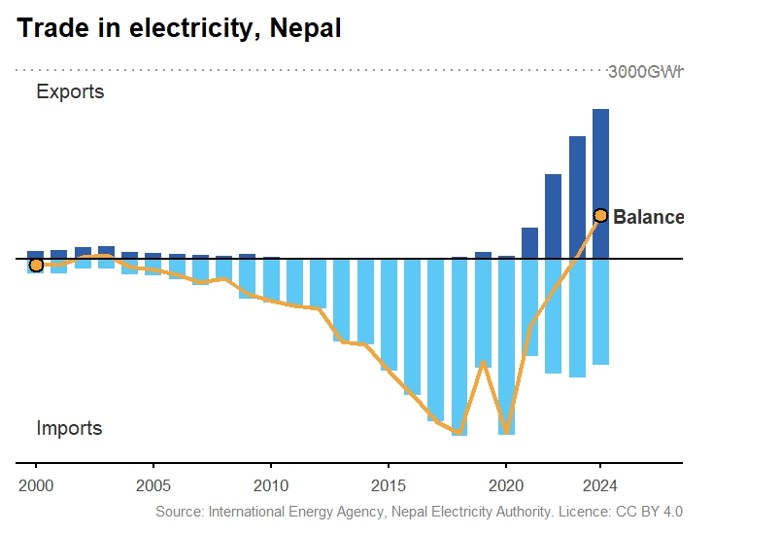
This narrative, however, has shifted significantly. Nepal has moved from a net importer to a net exporter of electricity, with the Nepal Electricity Authority (NEA) 2025 reporting that exports to India rose to 2,380 GWh, 22.3% higher than the previous year. This transition reflects that Nepal’s clean energy transition is becoming a story of grid diplomacy, not just domestic infrastructure.
Recent data illustrate the scale of Nepal’s transition. Nepal’s net export to India was 699 GWh in the year 2024–25, and imported energy from India made up only 12.13% of the total demand, which is 17.42% less than the previous year.
Nepal’s Electricity Trade Data: From Chronic Importer to Net Exporter
Nepal possesses abundant water resources and an estimated hydropower potential of up to 83,000 MW, of which about 43,000 MW is considered technically feasible.
Recent trends show that dry season import volumes have declined steadily as domestic installed capacity grew.
Recent data illustrate the scale of Nepal’s transition. Nepal’s net export to India was 699 GWh in the year 2024–25, and imported energy from India made up only 12.13% of the total demand, which is 17.42% less than the previous year. This made Nepal a net electricity exporter.
Nepal’s electricity trade with India has historically been seasonal, with exports during the wet season and imports during the dry season when hydropower generation falls. Recent trends show that dry season import volumes have declined steadily as domestic installed capacity grew. This suggests a steady strengthening of Nepal’s domestic generation capacity. There have been significant gains in network efficiency and capacity expansion also. System losses also fell from 28.35% in 2011 to 12.26% in 2025, while transmission-specific losses reduced to 3.99% in 2025.
The figure below shows Nepal’s energy trade with India.
Source: International Energy Agency; Nepal Electricity Authority.
Nepal’s abundant water resources, combined with sustained investments in hydropower, have strengthened its position as an emerging energy player in South Asia.
Policy Reforms That Enabled Nepal’s Electricity Exports
India and Nepal have cooperated in the hydropower sector since the late 1950s. India has assisted Nepal in building several hydropower projects, starting with the Koshi and Gandak projects. Nepal have been conducting electricity trade with India since the 1960s, importing electricity from Bihar and Uttar Pradesh. However, the trade was overwhelmingly one-directional, with Nepal functioning as an importer.
The 1996 Mahakali Treaty marked an important milestone to strengthen cooperation on water resources, irrigation, and hydropower developments, though implementation remained slow due to political disagreements and differing expectations around benefit sharing. Nepal also undertook policy reforms like the Electricity Act of 1992 and the 2001 Hydropower Development Policy, along with subsequent institutional measures to strengthen electricity governance and attract investment.
In 2014, India and Nepal signed the Power Trade Agreement during Prime Minister Modi’s visit to Kathmandu, giving cross-border electricity trade, transmission interconnection, and grid connectivity a formal legal base and helping revive bilateral energy cooperation. However, the agreement’s strategic importance became fully visible only after India’s Cross-Border Trade of Electricity (CBTE) Guidelines, issued in 2021. These guidelines provided Nepal with a transparent and rules-based mechanism to access India’s electricity markets through designated transmission corridors. Consequently, the NEA gained access to India’s Day-Ahead Market and Real-Time Market, enabling Nepal to sell electricity competitively rather than relying solely on negotiated bilateral transactions. This integration is further reinforced by the Long-Term Power Agreement between India and Nepal, which envisages the sale of up to 10,000 MW of power from Nepal to India in the next 10 years. Recent estimates indicate that Nepal supplied nearly 400 MW of continuous electricity to India during the 2024 monsoon season and is actively pursuing opportunities to expand exports further. With these developments, Nepal is on track to become the leading hydropower exporter in South Asia.
Expanded hydropower generation and improvements in transmission infrastructure have let Nepal eliminate chronic load shedding and generate exportable electricity surpluses.
Looking ahead, Nepal has set an ambitious target of achieving 28.5 GW of installed hydropower capacity by 2035, with nearly 15 GW earmarked for exports to India and Bangladesh. This makes Bangladesh a partner in Nepal’s ambition as well.
Beyond Bilateralism: Nepal–India–Bangladesh Grid Cooperation
Nepal’s electricity export story is no longer confined to a bilateral framework. Power trade that has long continued with India for a long time has now expanded to include electricity exports to Bangladesh. Under the landmark 2024 trilateral agreement between NEA, Bangladesh Power Development Board, and India’s NTPC Vidyut Vyapar Nigam, Nepal will supply electricity to Bangladesh from June 15 to November 15 for five years, transmitted via India’s 400-kV Muzaffarpur–Baharampur–Bheramara line. This deal marks a significant step in regional energy cooperation and positions India as a crucial facilitator of cross-border electricity trade in South Asia.
Looking ahead, Nepal has set an ambitious target of achieving 28.5 GW of installed hydropower capacity by 2035, with nearly 15 GW earmarked for exports to India and Bangladesh. This makes Bangladesh a partner in Nepal’s ambition as well. Achieving these objectives would fundamentally reshape Nepal’s economy by positioning renewable energy as a major export sector capable of attracting investment, creating employment, and supporting industrial development. This trilateral cooperation not only benefits Nepal economically but also enhances energy security and integration across South Asia.
Himalayan grid diplomacy therefore represents more than just bilateral infrastructure projects. It reflects a broader reimagining of regional cooperation in South Asia, where interconnected electricity systems generate not only renewable energy but also economic resilience and long-term strategic partnerships.
Powering Sustainable Statecraft in South Asia
Sandwiched between India and China, Nepal has historically had to balance economic and strategic constraints. Now, as Nepal prepares to transition from the least developed countries category to that of developing nations, its foreign policy is increasingly geared towards utilising electricity trade to foster stability, augment its strategic value, and contribute to sustainable growth. Hydropower has increasingly become an instrument of Nepalese statecraft.
This shift has also reshaped Nepal’s economy through foreign exchange gains and reduced fossil-fuel dependence. According to the NEA (2025), electricity exports generated approximately NPR 1,747 crore during FY2024–25.
Nepal’s journey from 18-hour blackouts to becoming a net power exporter is a story of resilience, reform, and vision. As Nepal expands generation capacity, export revenues are expected to increase further, reducing dependence on imported petroleum products while improving the country’s trade balance. It also provides India an opportunity to tap into Himalayan hydropower resources while expanding its renewable energy portfolio through investments in Nepal’s power sector. Thus, the future lies not just in generating electricity, but in building an integrated regional grid for sustainable development across borders.


Abhishek Agarwal

Find on this page

The Centre for Social and Economic Progress (CSEP) is an independent, public policy think tank with a mandate to conduct research and analysis on critical issues facing India and the world and help shape policies that advance sustainable growth and development.