

CSEP at Bangkok Climate Action Week 2026
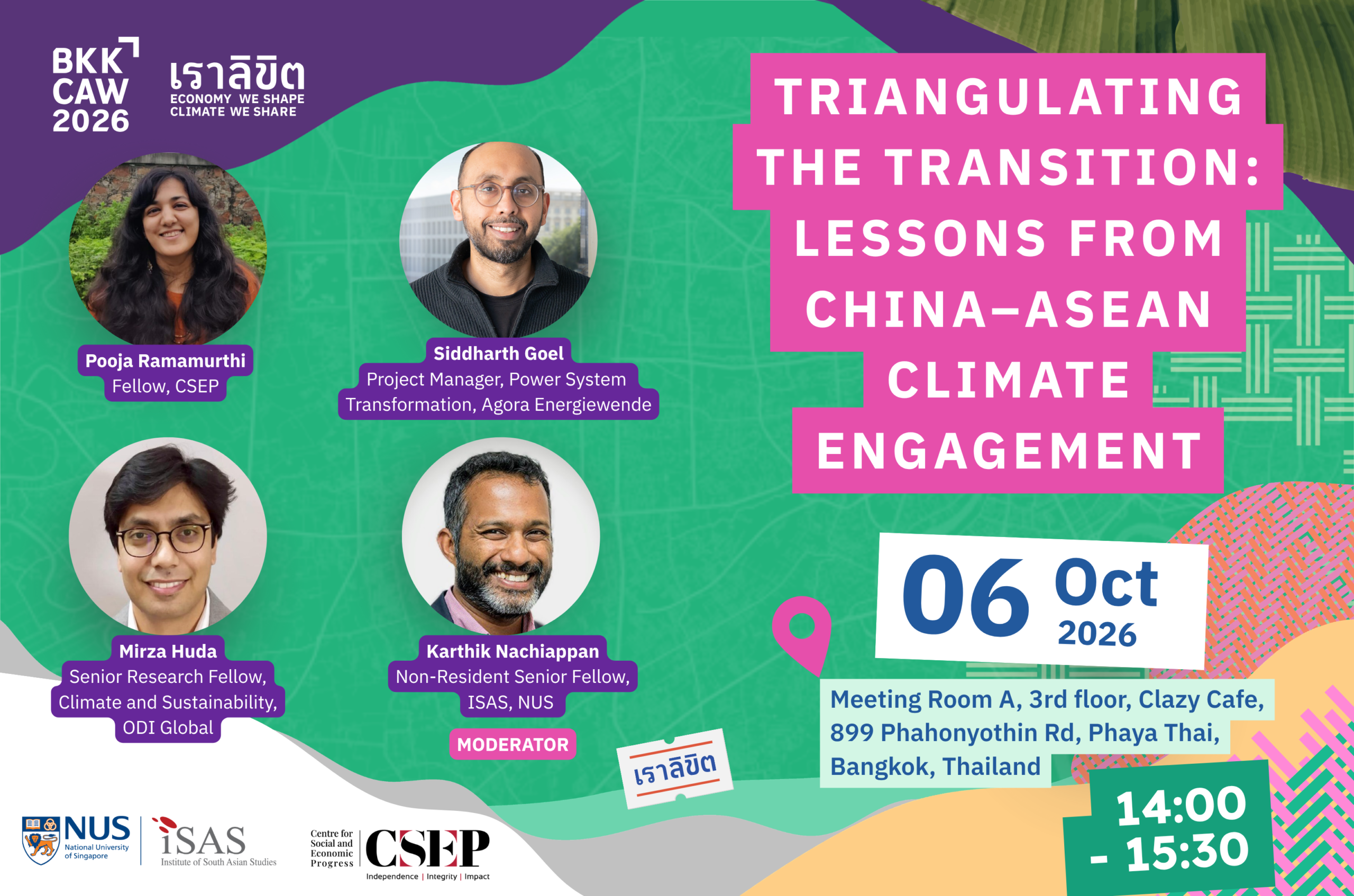
This session by the Institute of South Asian Studies(ISAS), National University of Singapore (NUS) and the Centre for Social and Economic Progress(CSEP), New Delhi will examine China’s engagement with ASEAN on climate and the energy transition, and consider what India can learn from these experiences while accounting for its own strategic, economic, technological, and institutional context.
Objectives
Assess China–ASEAN climate engagement across mitigation and adaptation: Map the channels through which cooperation occurs, including investment, clean-tech supply chains, the ASEAN Power Grid, standards-setting, green finance, policy exchanges, capacity-building, and subnational partnerships, and evaluate their results.
Identify transferable lessons and safeguards for India: Determine which ASEAN experiences with China could support India’s energy transition and climate action, while considering guardrails relating to domestic manufacturing, environmental and social standards, technological dependence, and local institutional capacity.
Develop a practical agenda for selective India–China climate cooperation: Identify concrete pathways for technical exchanges, research collaboration, city-level partnerships, private-sector engagement, and institutional coordination between India and China, particularly where ASEAN experience offers tested approaches or reveals implementation risks.
The objective is to move towards a practical and selective agenda for India–China climate cooperation, grounded in evidence from China’s engagement with ASEAN rather than treating regional cooperation as a one-size-fits-all model.
Panellists:
- Pooja Ramamurthi, Fellow, CSEP
- Mirza Sadaqat Huda, Senior Research Fellow, ODI Global
- Siddarth Goel, Project Manager, Agora Energiewende
Moderater:
- Karthik Nachiappan, Non Resident Senior Fellow, ISAS, NUS
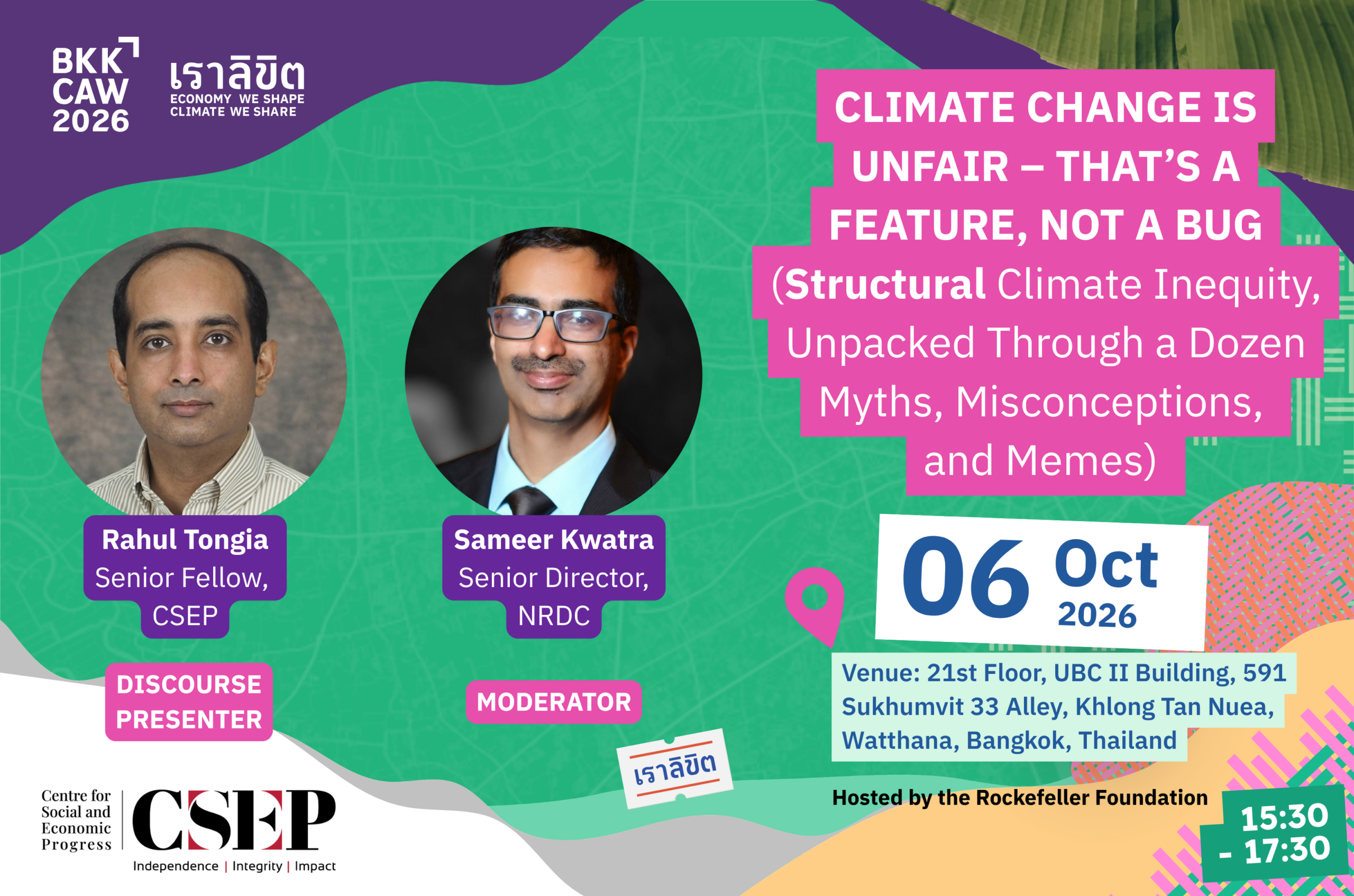
There’s not enough happening in terms of action around climate change On part the world is distracted to the pint that energy security trumps other considerations but there is also a disconnect. Who should do what? By when? How do we handle the multiple and sometimes competing objective functions. Equity was meant to be addressed by framework of Common But Differentiated Responsibilities (CBDR), but this has proven to be vague, contentious and inadequate. The poor felt it wasn’t enough while the rich felt was too generous. In a special visual discourse, Rahul Tongia ( Senior Fellow, CSEP) argues how climate change inequity isn’t just an artificial of history or negotiation, it’s structural. Unless we tie together all the issues typically ignored or left as a secondary problem, we will have delay, insufficient ambition, and lagging action. Using data, asking fundamental questions, and ultimately drawing us toward solutions, the conversation takes you on a journey through the hidden or forgotten aspects of climate change frameworks and why we need to come up with new solutions that are both more acceptable and actionable.
This session will be moderated by Sameer Kwatra, Senior Director (India, International) NRDC.
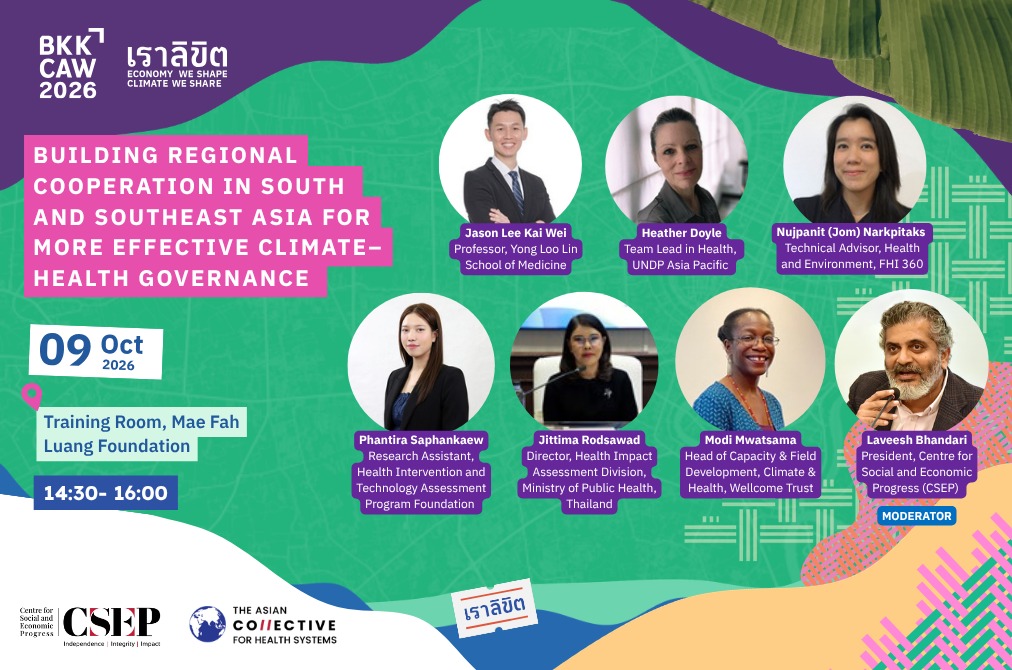
The panel aims to identify and examine shared climate–health governance challenges across South and Southeast Asia, with a focus on how climate impacts disproportionately affect vulnerable populations and place pressure on health systems. As well as facilitate knowledge exchange and peer learning among policymakers, researchers, practitioners, and regional networks on effective approaches for integrating health considerations into climate policies, adaptation planning, and resilience-building efforts.
The panel will explore opportunities for stronger regional cooperation, partnerships, and communities of practice that can advance coordinated, equitable, and locally informed climate–health action across South and Southeast Asia. This contributes to inclusive climate action by fostering collaboration across countries and sectors, enabling shared solutions, mutual learning, and collective responses to transboundary climate and health challenges.
Panellists:
- Jittima Rodsawad, Director, Health Impact Assessment Division, Department of Health, Ministry of Public Health, Thailand
- Jason Lee Kai Wei, Professor, Yong Loo Lin School of Medicine; Director, Heat Resilience and Performance Centre, National University of Singapore
- Heather Doyle, Team Lead in Health, UNDP Asia and Pacific Region
- Modi Mwatsama, Head of Capacity & Field Development, Climate & Health, Wellcome Trust
- Nujpanit “Jom” Narkpitaks, Technical Advisor, Health and Environment, FHI 360
- Phantira Saphankaew, Research Assistant, Health Intervention and Technology Assessment Program Foundation (HITAP)


The Centre for Social and Economic Progress (CSEP) is an independent, public policy think tank with a mandate to conduct research and analysis on critical issues facing India and the world and help shape policies that advance sustainable growth and development.