
MacroInsights: Rupee Defence – Why is it Proving so Difficult?
Reading Time: 4 minutesMacroInsights, a Centre for Social and Economic Progress (CSEP) series, dissects key economic developments and policy issues of macroeconomic significance. It offers timely, evidence-based analysis to inform public debate and policymaking.
The underlying imbalance needs addressing; short-term measures can only provide a breather
India’s currency pressures have persisted for over two years, intensifying through 2026. Neither heavy intervention nor successive support measures have reversed the rupee’s drift or shifted market expectations. Foreign capital drying up is not new, but its acceleration in 2026 has added to a cumulative deterioration since at least 2023. The growing stock of short forward positions adds another layer of vulnerability. Government efforts to attract direct and short-term foreign capital have so far provided only temporary relief. The central problem remains: India’s strong growth is not matched by investment — domestic or foreign.
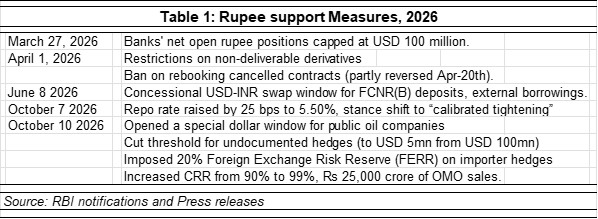
Less than a month after mobilising ~US$150 billion through concessional deposits and swaps, the RBI announced further measures to support the rupee. The 25-bps repo hike (October 7, 2026) and the October 10 measures cap a sequence of actions since March (Table 1). The special swap window, which ended in mid-September, was intended to break the downward spiral in currency expectations. Yet the rupee’s slide has continued. The RBI has already used ~US$96 billion, 64% of the amount – it is not known if and how much may have been deployed towards unwinding forwards’ position. Taking out oil-import payments off-market, the implicit monthly intervention is ~US$10-11 billion. This indicates persistent underlying pressure.
The question, therefore, is not whether the RBI has sufficient firepower. It is whether intervention can alter a market perception that the underlying balance of payments is deteriorating.
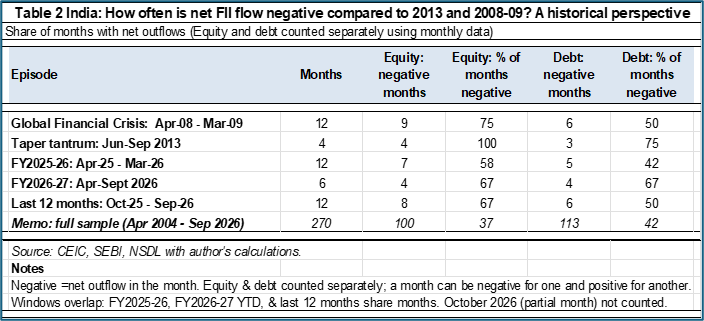
Foreign capital outflow is persistent but remain below the extremes during 2013 and 2008–09. Equity and debt flows have both been negative in four of the six months since April. Over the latest twelve months, equity recorded net outflows in eight of twelve months and debt in six. What distinguishes the current episode is therefore not the magnitude of monthly outflows but their persistence. The weakness has extended for around 18 months, compared with four months in 2013 and roughly a year in 2008-09. There is also no single identifiable crisis trigger. The deterioration has occurred without a conventional sudden-stop event: persistent capital-account weakness requires a different response from a short-lived external shock.
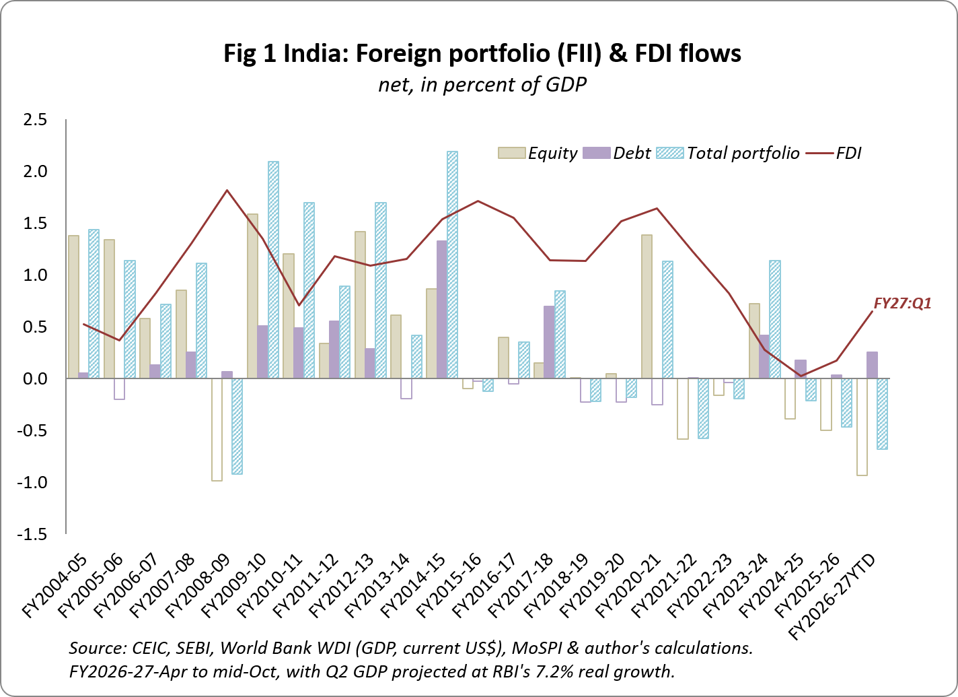
The warning signs predate the current currency pressure (Figure 1). Net FDI has stayed below one per cent of GDP for close to five years, mirroring weak domestic investment. An economy growing at ~8 per cent would ordinarily generate strong investment demand and, where domestic savings are insufficient, corresponding capital inflows. The broad-based and persistent deficit points to structural forces, with cyclical factors playing a lesser role.
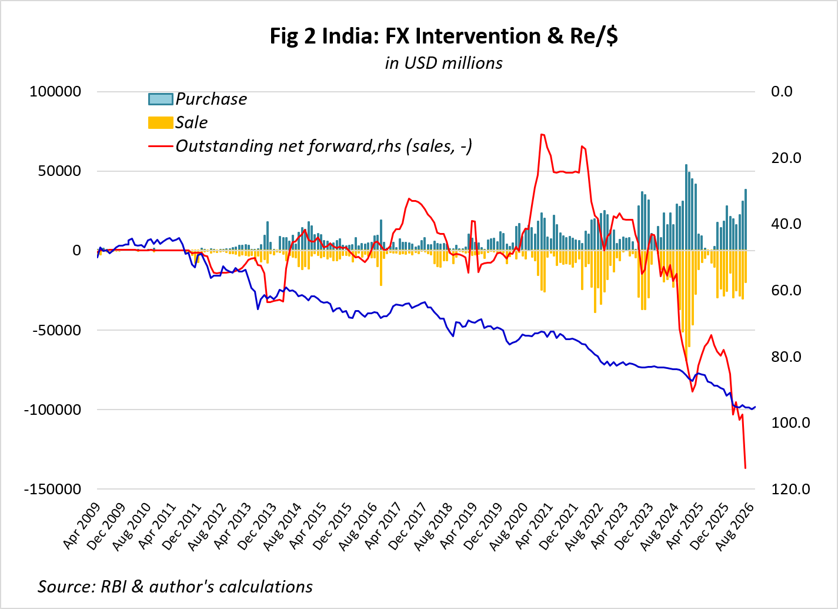
Prolonged intervention signals beliefs at odds with the market’s – that pressures are transitory, and capital inflows will resume. The RBI’s spot and forward interventions have risen sharply since late 2023 (Figure 2). The forward book, after briefly declining, has again accumulated rapidly, reaching an estimated US$200 billion. Yet this has not arrested the currency’s downward trend. An awkward policy signal is created when a country with large reserves and strong headline growth is increasingly mobilising its central bank balance sheet to attract or retain foreign currency while intervention itself creates future foreign-currency obligations. Markets may therefore distinguish between gross reserve strength and usable external resilience.
Depreciation expectations remain firmly entrenched. The persistence of rupee weakness suggests that markets have not materially changed their expectations about the currency’s medium-term path. The latest measures may provide near-term liquidity and reduce disorderly movements, but they have not yet generated evidence of a fundamental shift in the balance-of-payments outlook. This creates a potentially self-reinforcing dynamic: depreciation expectations urge hedging and capital outflows, rising intervention and forward position, while future liabilities reinforce caution about the currency. Markets are responding to the disconnect between official signals and fundamentals.
Can controls turn the structural story without a reversal in foreign capital? This is the central policy question. Restrictions on derivatives, tighter hedging rules, temporary incentives for deposits and foreign investment, and intervention can all provide breathing space. But an over-extended currency defence has rarely worked as suggested by past two years’ experience – repeated intervention has slowed adjustment without reversing it.
Tough questions, tougher path ahead. Further monetary tightening may eventually be required to support the currency, but this would come at a cost. Higher rates could weaken consumption after substantial monetary and fiscal support last year and interrupt a nascent recovery in private investment. The harder question macro question is: has the capital account become more important than the current account in determining the rupee’s sustainable equilibrium?
This may increasingly be determined by the capital account rather than the current account which is well below its sustainable threshold. That is the structural issue that short-term defence measures cannot resolve.

Renu Kohli



Find on this page

The Centre for Social and Economic Progress (CSEP) is an independent, public policy think tank with a mandate to conduct research and analysis on critical issues facing India and the world and help shape policies that advance sustainable growth and development.