
Unlocking India’s Diplomatic Archives: Declassification, Secrecy, and Public Memory
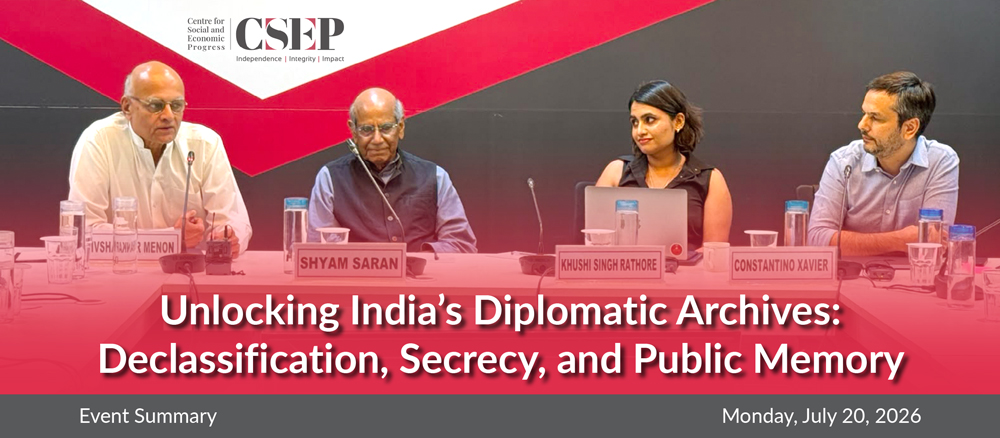
- The Centre for Social and Economic Progress (CSEP), in partnership with King’s College London, NYU Abu Dhabi, and the New International Histories of South Asia (NIHSA) network, hosted the fourth session of its Archives and Policy Seminar Series, titled “Unlocking India’s Diplomatic Archives: Declassification, Secrecy, and Public Memory” on July 20, 2026. The discussion examined the challenges surrounding the declassification and public accessibility of official records in India.
- The discussion featured Ambassador Shyam Saran, former Foreign Secretary of India, who shared insights on declassification, state secrecy, institutional memory, and public access to official records. Welcome remarks were delivered by Ambassador Shivshankar Menon, Distinguished Fellow, CSEP and Constantino Xavier, Senior Fellow, CSEP. The discussion was moderated by Khushi Singh Rathore, Max Weber Fellow, EUI and Non-Resident Associate Fellow, CSEP.
- The seminar brought together policymakers, former officials, archivists, and scholars for a focused conversation on the institutional and procedural barriers to declassification. The session explored declassification as part of the broader life cycle of official records rather than as an isolated administrative exercise. Participants discussed the need to strengthen record-making practices, establish clearer procedures for reviewing classified material, improve archival catalogues, and develop institutional capacity across central, state, and non-state archives.
- The Archives and Policy Seminar Series is a closed-door discussion platform curated by CSEP, King’s College London, NYU Abu Dhabi, and the NIHSA network to explore challenges and policy solutions for improving archival access and governance in India.
- Initiated by Shivshankar Menon; Constantino Xavier; Bérénice Guyot-Réchard, Reader (Associate Professor) in International and South Asian History, King’s College London; and Rahul Sagar, Associate Professor of Political Science, NYU Abu Dhabi, the series is curated by Khushi Singh Rathore.
Record Creation and the Foundations of Institutional Memory
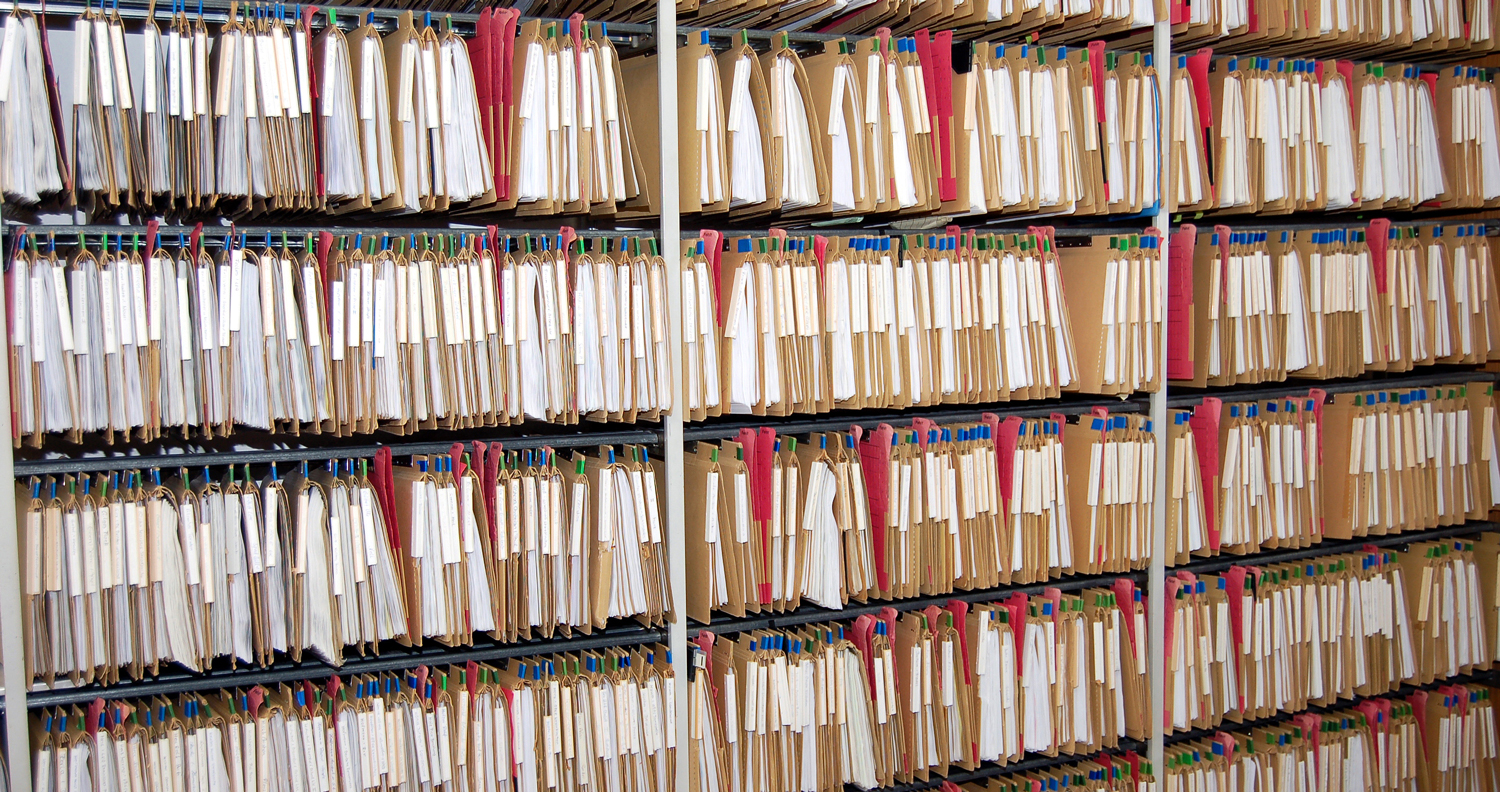
The session began by locating declassification within the wider process through which official records are created, preserved, reviewed, transferred, and eventually made accessible. It was noted that declassification cannot function effectively when significant meetings, conversations, and policy decisions are not adequately documented in the first place. The weakening of systematic record-making therefore affects not only future historical research but also the ability of institutions to retain and draw upon their own knowledge.
The growing use of electronic communication, messaging platforms, and other informal digital channels has complicated this process. While digital technologies make recording, transcription, and storage easier, important exchanges may remain outside formal systems of record management. The discussion highlighted the need for clearer rules identifying which digital communications constitute official records and establishing how they should be preserved, transferred, and reviewed.
A broader concern was the gradual erosion of historical and archival capacity within government institutions. When ministries lack dedicated personnel and established procedures for managing their records, institutional memory becomes dependent on individuals rather than durable administrative systems.
Declassification, Review, and Administrative Capacity
A major theme of the session was the gap between formal expectations of periodic declassification and the institutional capacity available to undertake it. Officials responsible for current policy may have limited time or resources to review large volumes of historical files. In the absence of specialised mechanisms, records may remain classified long after their sensitivity has diminished.
The discussion also examined the role of administrative caution. Entire files may continue to be withheld even when only a small portion contains sensitive information. It was suggested that more consistent use of partial redaction could allow nonsensitive material to be released while protecting information that remains legitimately restricted. Time-bound review mechanisms involving retired officials, archivists, and subject specialists were discussed as one possible way to address accumulated backlogs.
Participants noted that continued non-disclosure does not always indicate that a record remains sensitive. In some cases, institutions may be unable to locate the relevant file or determine whether it was transferred, retained, destroyed, or misplaced. Declassification reform must therefore address record management and institutional accountability alongside classification policy.
Catalogues, Archival Absence, and Public Access
The participants emphasised that meaningful archival access begins before a researcher requests an individual file. Users must first be able to establish what records exist, where they are held, what has been transferred, and what remains classified or unavailable. Incomplete catalogues and transfer lists make it difficult to distinguish between restricted records, missing files, and material that was never preserved.
Publishing comprehensive catalogues and indices was identified as an important transparency measure. Even when immediate access cannot be provided, the existence and status of a record should be visible. Such catalogues could also indicate whether files are classified, partially available, under review, missing, or scheduled for future release.
This led to a wider discussion of archival absence. Public accountability requires attention not only to records that are accessible but also to what has not been created, transferred, catalogued, preserved, or released. A more transparent accounting of such absences would help researchers identify structural gaps in the documentary record and better understand the limits of available evidence.
Official Records, Alternative Archives, and Historical Knowledge
Participants noted that when Indian official records remain inaccessible or incomplete, histories of Indian policy are often reconstructed through foreign government archives, intelligence records, international organisations, private papers, memoirs, and oral histories. These sources can provide valuable evidence, but they also reflect their own institutional perspectives, political interests, and documentary practices.
Greater access to Indian official records would enable scholars to develop more grounded accounts of the country’s diplomatic, political, and administrative history. It would also strengthen the capacity of state institutions to understand previous decisions, learn from historical experience, and maintain continuity across changes in personnel and government.
The conversation extended beyond central government repositories to the wider archival ecosystem. State and regional archives frequently face shortages of staff, funding, cataloguing infrastructure, and preservation capacity. Community archives, caste archives, people’s collections, oral histories, and other non-state initiatives can complement official records by preserving experiences that are often absent from government files. Future archival policy must therefore account for the multiple institutions and communities through which public memory is produced.
Toward a More Coherent Declassification Framework
The discussion concluded with an emphasis on practical and institutional reform. Suggested directions included rebuilding archival and historical capacity within ministries; developing ways or mechanisms for recording insights from significant meetings and digital communications; establishing timebound declassification reviews; involving retired officials and subject specialists in the review process; and adopting partial redaction more consistently.
Formation of specialised review panels comprising retired Foreign Service officers was suggested; this could help address the shortage of personnel available for declassification. Working within defined mandates and timelines, these panels could support ministries in reviewing accumulated backlogs of classified files.
Participants also highlighted the importance of publishing catalogues and record-transfer lists, reviewing file-retention and destruction procedures, and mapping the condition of record rooms across institutions. Strengthening state and regional archives, while recognising the contribution of community and oral-history initiatives, was seen as essential to developing a more representative archival ecosystem.
The session underscored that declassification is not simply the opening of old files. It depends on an interconnected system governing how records are created, classified, stored, preserved, reviewed, transferred, discovered, and accessed. Strengthening this system is essential for public accountability, institutional memory, historical scholarship, and better-informed policymaking.







The Centre for Social and Economic Progress (CSEP) is an independent, public policy think tank with a mandate to conduct research and analysis on critical issues facing India and the world and help shape policies that advance sustainable growth and development.