
Connectivity and the Future of India–Nepal Relations
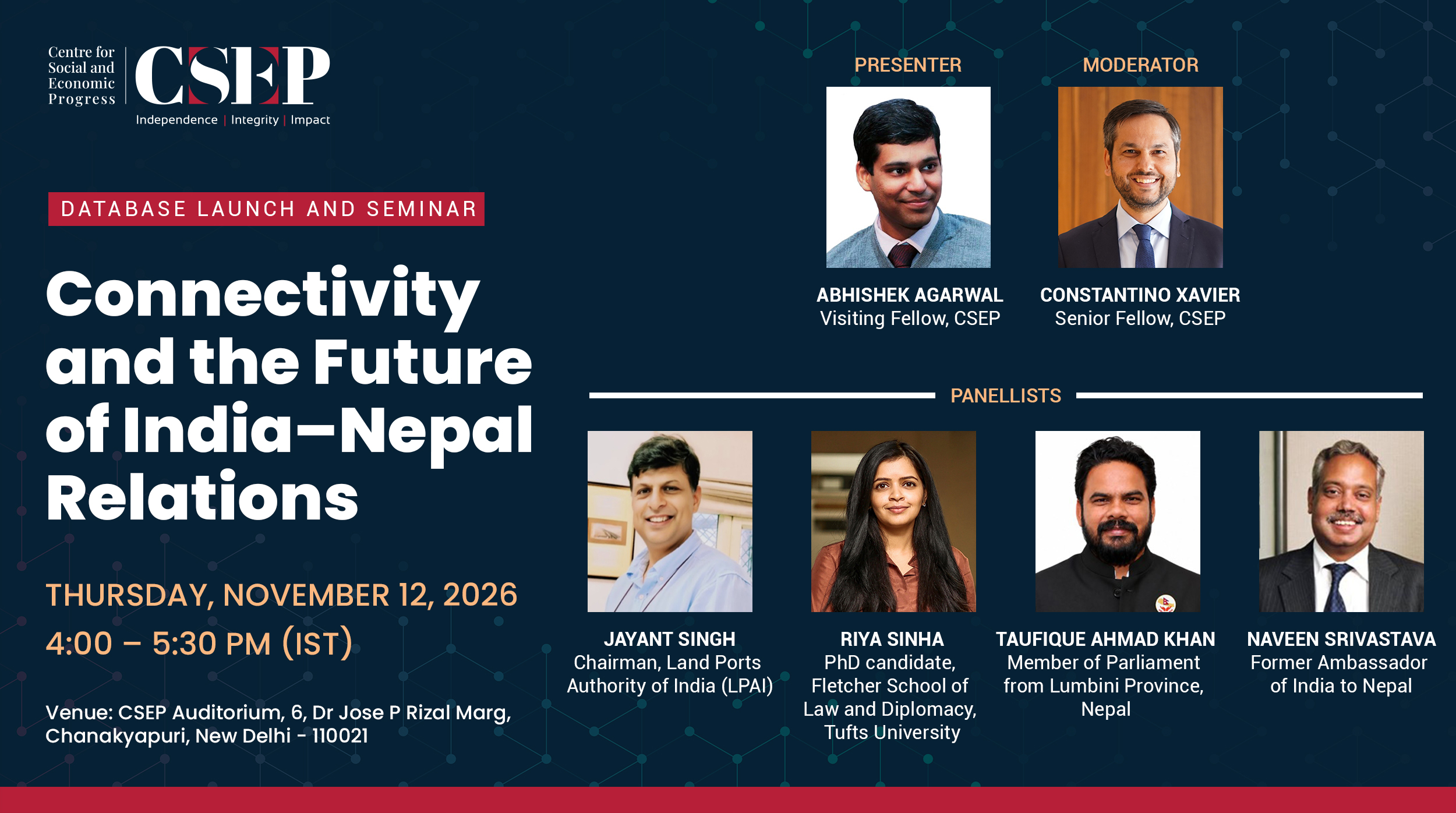
The Centre for Social and Economic Progress (CSEP) is pleased to invite you to the Database Launch and seminar, “Connectivity and the Future of India–Nepal Relations”. The seminar launches the new Nepal phase of the Sambandh Connectivity Database and Map, followed by a panel discussion on cross-border infrastructure and the future of India-Nepal ties as New Delhi prepares to host Nepal’s Prime Minister Balendra Shah.
The event will begin with a presentation on the database by Abhishek Agarwal, Visiting Fellow, CSEP. This will be followed by a panel discussion with Jayant Singh, Chairman, Land Ports Authority of India (LPAI); Riya Sinha, PhD candidate, Fletcher School of Law and Diplomacy, Tufts University; Taufique Ahmad Khan, Member of Parliament from Lumbini Province, Nepal; and Naveen Srivastava, Former Ambassador of India to Nepal. Constantino Xavier, Senior Fellow, CSEP will moderate the discussion.
The seminar will be held on Thursday, November 12, 2026, from 4:00 to 5:30 pm at the CSEP Auditorium, 6, Dr Jose P Rizal Marg, Chanakyapuri, New Delhi – 110021.
Please note that this is an in-person event only. If you are in Delhi on the day, we invite you to join us for what promises to be a thought-provoking discussion. The event will be available on the CSEP website and YouTube channel upon completion.
About the event
After Bhutan, the launch of the Nepal phase expands the CSEP Sambandh Connectivity Database and Map to around 150 cross-border infrastructure links. This includes detailed files on approximately 100 India-Nepal cross-border links in the transportation and energy sectors, including dozens of new roads, railways, ICPs, power transmission and petroleum pipelines. The repository offers a new tool for scholars, government and industry decision-makers focused on the rapid transformation of the India-Nepal borderlands and the effect of new connectivity initiatives on bilateral trade and economic interdependence.
The panel discussion will focus on three key questions:
- Connectivity and cross-border cooperation: How can India and Nepal accelerate new transport links, trade infrastructure and cross-border networks to further facilitate the movement of people, goods and services? What role can border states and provinces play for India to deliver even more, better and faster?
- The future of India–Nepal relations in a changing sub-region: How can both countries build a more resilient and mutually beneficial partnership through economic cooperation and integration in the BBIN sub-region? What are the main risks, obstacles, and opportunities in different sectors, from trade to hydropower?
- Connectivity, geoeconomics and security: What role do other actors play in a more regionally connected Nepal, including China, the United States, the European Union and multilateral banks? What risks and challenges does this pose for India’s economic and security interests, given the open border?
Panellists
Jayant Singh
Jayant Singh is a career civil servant with over three decades of experience in the Government of India across sectors ranging from logistics to training & capacity building and national security. His current appointment is as Chairman, Land Ports Authority of India under the Ministry of Home Affairs, Government of India. He has served as a senior faculty member at the Lal Bahadur Shastri National Academy of Administration, Mussoorie. He also worked as Joint Secretary in the National Security Council Secretariat under the Prime Minister’s Office. He served with distinction as the Vice Chairman in the Inland Waterways Authority of India, where he worked extensively towards creating a viable Inland Water Transport ecosystem and contributed towards doubling the quantum of traffic on waterways in two and a half years.
He is an alumnus of The Air Force School Delhi & St Stephen’s College, Delhi University, from where he did his graduation and post-graduation in History; and the London School of Economics, from where he obtained an MSc degree in Public Management and Governance. He also holds an MPhil degree from the National Defence College, New Delhi. Belonging to the 1993 batch of the Indian Railways Traffic Service, he has served in various capacities in the field and the Ministry, most notably in the Container Corporation of India, where he set up a number of multimodal logistics terminals and was associated with the launch of the first double stack container train in Asia. Prior to joining his current assignment, he served in NITI Aayog, the premier government think tank, where he handled the Infra and Logistics division besides Rural Development and Tourism. His interests include global geostrategic affairs, history and Political Economy.
Riya Sinha
Riya Sinha is a PhD candidate at the Fletcher School of Law and Diplomacy, Tufts University. Her research focuses on border management and regional economic connectivity in South Asia, combining fieldwork, policy analysis and data-driven methods to study cross-border infrastructure development, connectivity and regional cooperation.
She has held research positions at various leading think tanks and policy institutions. Most recently, she was an Associate Fellow in the Foreign Policy and Security Studies vertical at the Centre for Social and Economic Progress (CSEP), New Delhi (formerly Brookings India). She co-led the Sambandh Initiative on India’s regional connectivity and also led the development of the Sambandh Database and Map, a first-of-its-kind visualisation of India’s physical linkages with its neighbourhood.
Taufique Ahmad Khan
Taufique Ahmad Khan is a Member of Parliament in Nepal’s House of Representatives, representing Rupandehi-5 in Lumbini Province. His work focuses on public policy, governance, sustainable development and environmental policy, with an emphasis on strengthening local institutions and promoting inclusive economic growth.
He has served in advisory roles with the Lumbini Cultural Municipality and Siddharthanagar Municipality, providing guidance on strategic planning, governance reforms and long-term development. He has also been involved in international cooperation, peacebuilding and cross-border collaboration, with a focus on regional cooperation and sustainable development.
Naveen Srivastava
Naveen Srivastava is a former member of the Indian Foreign Service with more than three decades of diplomatic experience. He recently completed his tenure as Ambassador of India to Nepal, where he served for more than four years. Ambassador Srivastava began his diplomatic career in Hong Kong, and subsequently served at the Embassy of India in Beijing, looking after bilateral relations between India and the People’s Republic of China. Ambassador Srivastava has also served at the Embassy of India in Washington, D.C. (June 2009 to July 2012), and as Consul General of India in Shanghai, China (August 2012 to July 2015). He served as Ambassador of India to the Kingdom of Cambodia from August 2015 to May 2017. He was on deputation to the New Development Bank (NDB), Shanghai, China (June 2017 to June 2019) as the Director General and Corporate Secretary of the Bank, where he worked with the President and the Board of the Bank.
At the headquarters in New Delhi, Ambassador Srivastava has served in the Disarmament & International Security Affairs Division, in the office of the Foreign Secretary, and has also led the East Asia Division of MEA, where he handled India’s relations with China, Japan, Republic of Korea, Mongolia and Democratic People’s Republic of Korea. Ambassador Srivastava holds a Bachelor’s degree in Electrical Engineering from the prestigious Indian Institute of Technology, Delhi and a Master’s degree in Electrical Engineering from the University of Maryland, USA. He also has a diploma in Mandarin (Putonghua) from Chinese University of Hong Kong.
Presenter
Abhishek Agarwal
Abhishek Agarwal is a Non-Resident Fellow at NITI Aayog and a Visiting Fellow at CSEP in New Delhi. Abhishek actively sows and nurtures ideas that develop into significant programs and reforms in infrastructure governance and cooperation management. Key past initiatives include PM GatiShakti, Integrated Infrastructure Planning, Infrastructure Digitalization, De-risking & Resilience, Alternate Financing Mechanisms, Smart Cities, RURBAN, City-Regions (Growth Hubs), District Area Development Approach, Leveraging Tourism, Vibrant Village Program, and Hierarchical Spatial Governance. Multi-sectoral collaborations, member of various committees, appraising ~1700 mega-projects ($640bn) and convergence framework for 5000 micro projects and facilitating bilateral and multilateral engagements are key recent highlights. Past associations include NITI Aayog, GIZ, UNDP, Odisha, Tamil Nadu, Rajasthan, IL&FS, GIFT City, Gujarat Tourism Opportunities (GUJTOP), Gujarat Industrial Infrastructure Projects Limited (GIIPL), and partnerships with various Industrial Development Authorities and Municipal Corporations. Abhishek is an alumnus of the prestigious International Visitors Leadership Program (IVLP) of the Department of State (Govt. of US) for ‘Cooperation on Infrastructure for the Indo-Pacific’.
Moderator
Constantino Xavier
Constantino Xavier is a Senior Fellow at CSEP, where he directs the program in Foreign Policy and Security Studies. He is also a non-resident fellow in the Foreign Policy program at the Brookings Institution, in Washington, D.C., and a visiting professor at Ashoka University’s Department of International Relations. His research expertise is on India’s role as a regional power in South Asia, the Bay of Bengal and Indian Ocean regions, especially relations with Nepal, Bangladesh, Sri Lanka and Myanmar. His studies under the CSEP Sambandh Initiative on Regional Connectivity have had wide impact with governments, industry and other stakeholders invested in enhancing India’s geoeconomic integration with neighbouring countries and regions, from the Gulf to Southeast Asia. His broader work explores how India navigates the geopolitics of a changing regional and global order by balancing national security interests and growing economic interdependence. He also focuses on India’s relations with the European Union and other Indo-Pacific powers across the Global South.
All content reflects the individual views of the speakers. The Centre for Social and Economic Progress (CSEP) does not hold an institutional view on any subject.
Please contact Gurmeet Kaur at GKaur@csep.org for general queries and Ayesha Manocha at AManocha@csep.org for media queries.





The Centre for Social and Economic Progress (CSEP) is an independent, public policy think tank with a mandate to conduct research and analysis on critical issues facing India and the world and help shape policies that advance sustainable growth and development.