

Seeking Relevance in the Turbulence: India and ASEAN
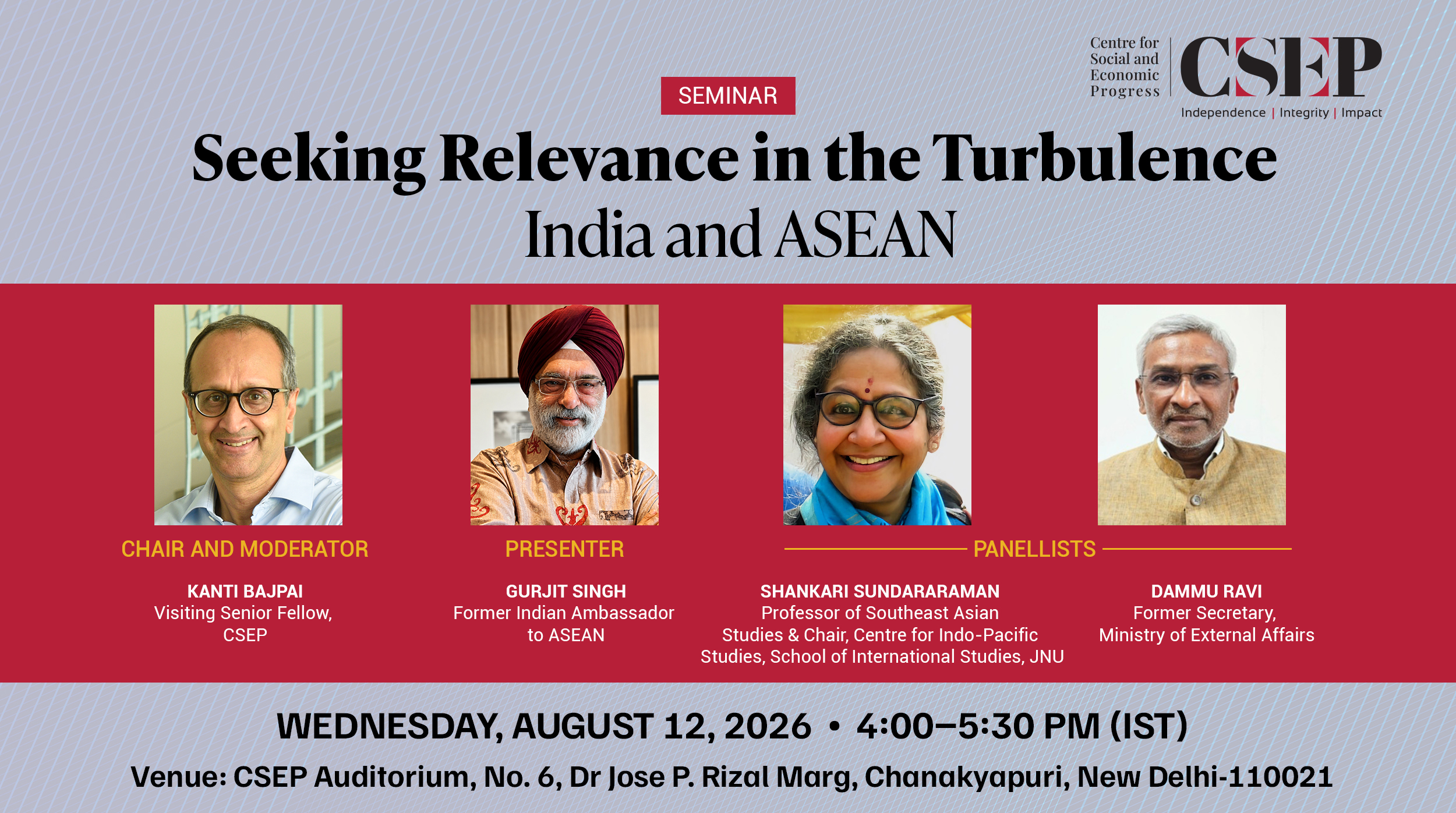
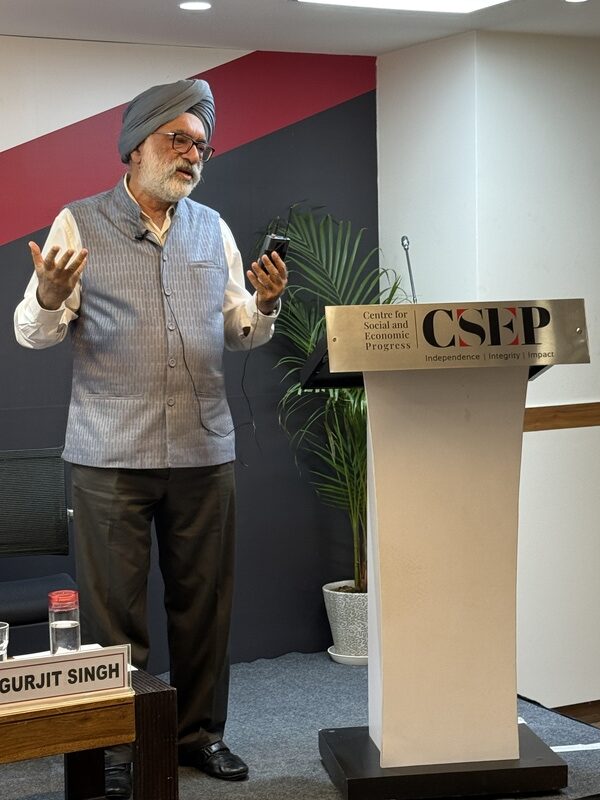
The Centre for Social and Economic Progress (CSEP) is pleased to invite you to a seminar titled “Seeking Relevance in the Turbulence: India and ASEAN” featuring a presentation by Ambassador Gurjit Singh, Former Indian Ambassador to ASEAN. This will be followed by comments from the panellists Shankari Sundararaman, Professor of South-East Asian Studies & Chair, Centre for Indo-Pacific Studies, School of International Studies, JNU and Dammu Ravi, Former Secretary, Ministry of External Affairs. The session will be chaired and moderated by Kanti Bajpai, Visiting Senior Fellow, CSEP.
The seminar will be held on Wednesday, August 12, 2026, from 4:00 to 5:30 pm (IST) at the CSEP Auditorium, 6, Dr Jose P Rizal Marg, Chanakyapuri, New Delhi – 110021.
Please note that this is an in-person event only. If you are in Delhi on the day, we invite you to join us for what promises to be a thought-provoking discussion. The event will be available on the CSEP website and YouTube channel upon completion.
About the event
Drawing on his recent book, The Durian Flavour: India and ASEAN after a decade of the Act East Policy, Ambassador Gurjit Singh will offer insights into the state of India’s relationship with Southeast Asia at a time of geopolitical churning and against the background of Prime Minister Narendra Modi’s recent trip to Indonesia, Australia, and New Zealand. The panel aims to assess policy options for the future as India aims to diversify its strategic options in the Indo-Pacific and integrate further with this dynamic region.
Presenter
Ambassador Gurjit Singh
Ambassador Gurjit Singh served as an Indian diplomat for 37 years, with postings in Germany, Indonesia, Timor-Leste, Ethiopia, and Djibouti, and as Ambassador to ASEAN and the African Union—making him the only Indian diplomat to hold both roles. He also served in Japan, Sri Lanka, Kenya, and Italy. A passionate advocate for ASEAN, he has travelled widely, written extensively, and is a leading voice on India’s engagement with Africa, ASEAN, and the Indo-Pacific. He is trained in Japanese and speaks it well.
His books include The Abalone Factor (1997) on India-Japan relations and Ther Injera and Paratha (2009) on the partnership with Ethiopia. His third book, Masala Bumbu (2015) shaped a fresh India-Indonesia agenda, while his comic Travels Through Time (2015) explored India–Southeast Asia civilizational ties. These were followed by Opportunity Beckons (2017), setting a new agenda for India and Germany. The Harambee Factor (2022) is the best record of India-Africa Economic and Development cooperation in the 21st century. The Mango Flavour (2024) and The Durian Flavour (2026) delve into India, ASEAN and the decade of the Act East Policy.
He is an Honorary Professor at IIT Indore, chaired the CII Task Force on Trilateral Cooperation in Africa, and promotes SDGs, and impact investment in Africa, ASEAN, and other trilateral efforts.
Panellists
Shankari Sundararaman
Shankari Sundararaman is Professor of Southeast Asian Studies and current Chair at the Centre for Indo-Pacific Studies, School of International Studies, Jawaharlal Nehru University. She joined Jawaharlal Nehru University in 2003 as an Associate Professor. Prior to this, she worked as a Research Officer and Research Fellow at the Institute for Defence Studies and Analyses (IDSA) from 1996 to 2003. She received her Doctorate from the Jawaharlal Nehru University in 1996 in International Relations and Southeast Asian Studies, where she wrote her PhD dissertation on the International Dimensions to the Cambodian Conflict.
She was a Visiting Fellow at the Asia-Pacific College of Diplomacy (APCD) at the Australian National University (ANU), Canberra from May to July 2005, where she worked on the trilateral relations between India, Indonesia and Australia. She was also a Visiting Fellow at the Centre for Strategic and International Studies (CSIS), Jakarta in 2006-2007 as an Asia Fellow, under the prestigious ASIA Fellows award which was coordinated by the Asian Scholarship Foundation, Bangkok, the University of Pennsylvania’s Institute for the Advanced Study of India (UPIASI) and funded by the Ford Foundation. During the course of this fellowship, her research was on the Effects of Globalization on Separatist Conflicts in Indonesia. She is one of the first scholars to visit conflict zones such as Aceh especially after the region opened up following the tsunami of 2004.
She is the author of several journal articles, chapters in books as well as two books titled Cambodia: The Lost Decades and Pluralism in India and Indonesia: Diversity in the Quest for Unity. She has been a columnist with two national dailies, including The Asian Age, in which she wrote a four-year running column titled “Another Asia” focusing on national and regional issues in Southeast Asia from 2009-2013. From May 2020 she has been authoring a column in The New Indian Express titled Asian Axis, again with a focus on issues critical to regional developments in Southeast Asia and the wider Indo-Pacific. She has also been a regular contributor to the web-based articles of the Kalinga International Foundation. She has been an active part of several track II dialogues between India and Southeast Asia as well as India and Australia. She is on the editorial board to two international journals. Her teaching assignments cover the Master’s and Doctorate programmes at the School of International Studies, JNU. She has also supervised 30 MPhil scholars and 14 PhD scholars.
Dammu Ravi
Dammu Ravi retired as Secretary (Economic Relations) in the Ministry of External Affairs in August 2025.
He joined the Indian Foreign Service in 1989 and did postings in Indian missions in Mexico, Cuba and Brussels in the 1990s. At Headquarters, in his capacity as Director (2002-2005), he handled India’s relations with West European countries, EU and UN on multilateral issues such as Development, Environment and Climate Change. As Joint Secretary for Latin America and Caribbean countries (2009-2013), he worked to deepen India’s engagement with the region.
During his deputation to the Department of Commerce (2014-2020), Mr Ravi handled India’s Trade Policy and World Trade Organization (WTO) issues and was India’s lead trade negotiator for the Regional Comprehensive Economic Partnership (RCEP).
As the Chief Coordinator for COVID during lockdown, he coordinated disbursement of medicines and equipment and evacuation of Indians abroad through Vande Bharat flights.
As Secretary (Economic Relations) in the Ministry of External Affairs from Aug 2021 – Aug 2025, Mr Ravi pursued India’s strategic objectives in the multilateral economic fora and geoeconomics context; promoted India’s Development Assistance to countries in the Global South; built partnerships with African countries and AU; worked on New and Emerging Strategic Technologies. Mr Ravi was India’s Sherpa for BRICS, IBSA, I2U2 and G7.
Mr Ravi has published several research papers on trade, investment, agriculture, economic cooperation and integration. He regularly writes articles for journals and does book reviews for various dailies/magazines.
Mr Ravi holds a Master’s degree in Political Science from Jawaharlal Nehru University, Delhi.
Moderator
Kanti Bajpai
Kanti Bajpai is Visiting Senior Fellow, CSEP, Visiting Professor, Department of International Relations, Ashoka University and Emeritus Professor, Lee Kuan Yew School of Public Policy, National University of Singapore.
Before this, he held academic positions at the Lee Kuan Yew School of Public Policy, National University of Singapore (2011-25), Department of Politics and International Relations, Oxford University (2009-2010), the School of International Studies, Jawaharlal Nehru University (1994-2003), and the Maharajah Sayajirao University of Baroda (1989-1991). He was Headmaster, The Doon School, India (2003-2009).
Dr Bajpai has also held various visiting positions – at Wesleyan University, the University of Illinois at Urbana-Champaign, the Rajiv Gandhi Institute for Contemporary Studies in New Delhi, the Joan B. Kroc Institute for Peace at Notre Dame University, the Brookings Institution in Washington, D.C., and the Australian Defence Force Academy (ADFA) in Canberra. In 2010, he was Distinguished Fellow, Institute for Defence Studies and Analyses (IDSA) in New Delhi.
His main areas of research are Indian foreign policy and national security, South Asia, Asian international and strategic thought, and international security.
Most recently, Dr Bajpai published the Routledge Handbook of China-India Relations (2026, with Manjari Chatterjee Miller and Selina Ho), How Realist is India’s National Security Policy (Routledge, 2023), India Versus China: Why They Are Not Friends (Juggernaut, 2021), and India, the West, and International Order (2019, with Siddharth Mallavarapu). He is currently working on a book on India’s security.
All content reflects the individual views of the speakers. The Centre for Social and Economic Progress (CSEP) does not hold an institutional view on any subject.
Please contact Gurmeet Kaur at GKaur@csep.org for general queries and Ayesha Manocha at AManocha@csep.org for media queries.






The Centre for Social and Economic Progress (CSEP) is an independent, public policy think tank with a mandate to conduct research and analysis on critical issues facing India and the world and help shape policies that advance sustainable growth and development.